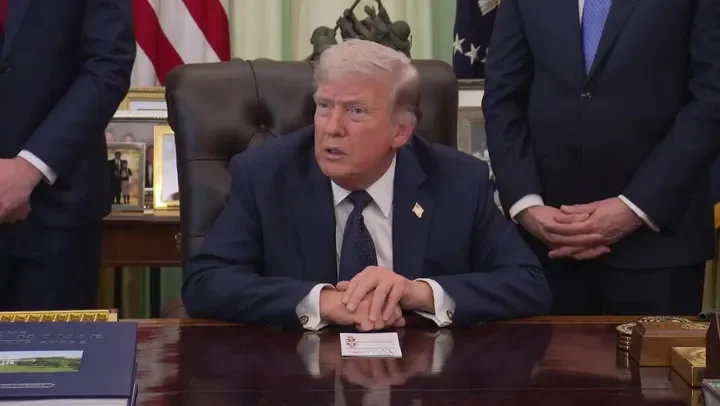
Recent pronouncements from President Donald Trump regarding the Iran war have faced significant challenges from independent observers, with claims of an imminent resolution or decisive victory being met with starkly different assessments. Sources indicate a consistent pattern of Trump projecting success that contrasts sharply with on-the-ground realities and expert analyses.
BBC correspondent Lyse Doucet, chief international correspondent for the corporation, directly countered Trump's assertion that the Iranian leadership is in crisis and eager for a deal. Her remarks, noted by multiple outlets, suggest a disconnect between the White House's narrative and the situation facing Tehran. Similarly, BBC US correspondent David Willis pointed out on Radio 4's Today programme that Trump had apparently failed to achieve the war's initial objectives, even after announcing a two-week ceasefire. These objectives, according to reports, included the dismantlement of Iran’s nuclear capabilities and the ousting of its government.
Read More: Labour NEC Blocks Andy Burnham's Return to Parliament
Further complicating Trump's narrative, a BBC expert, identified in one report as Gardner, explained on the same Radio 4 program that the war was demonstrably "going wrong" for the administration. He highlighted that Iran's Islamic republic regime had neither collapsed nor surrendered, and that Israel maintained a substantial list of targets within Iran, indicating a protracted conflict. This expert perspective suggests that aggressive military actions, particularly by Israeli forces, are continuing despite declarations of progress from the US president.
Trump's public statements on the war have also been flagged for factual inaccuracies. An analysis by CNN noted a specific instance where Trump claimed Vice President JD Vance was en route to Pakistan for negotiations with Iran, a claim that was reported as false. Earlier, Trump had reportedly boasted on social media about America having "already won" the conflict. He has also been accused of misrepresenting economic conditions, such as soaring gas prices and inflation, in his national addresses concerning the Iran war. The Associated Press has documented instances where Trump's claims about toppling Iran's government were contradicted by facts, despite the death of original leaders potentially leading to regime change.
Read More: China Denies Trump's Claim of 'Gift' on Seized Iranian Ship
Background: Escalation and Declarations
The conflict, which began with US and Israeli bombings of Iran in late February 2026, has seen Trump declare victory on multiple occasions. The war's escalation followed Iran's actions regarding the Strait of Hormuz, a critical oil transport route. Despite Trump's assertions, the underlying objectives of the military campaign have apparently remained unmet, according to journalistic reports and expert commentary.