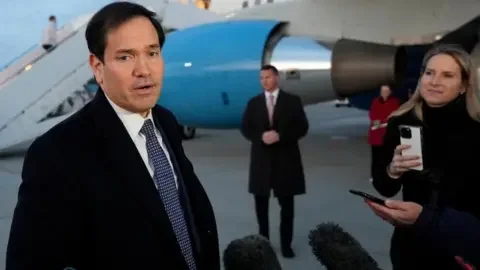
The Munich Security Conference has become a focal point for discussions about the future of Western alliances, with Secretary of State Marco Rubio delivering a notable address. His remarks signaled a potential shift in the United States' relationship with Europe, emphasizing a call for greater European self-reliance and a renewed focus on shared heritage, all while addressing concerns stemming from recent President Donald Trump administration actions. The conference, held against the backdrop of ongoing conflict in Ukraine and rising global tensions, saw European leaders grappling with the implications of these evolving dynamics.
Evolving Transatlantic Dynamics
Secretary Rubio's presence at the Munich Security Conference marked a significant moment in transatlantic relations. His speeches and interactions with European leaders have underscored a dual message: a commitment to the enduring partnership between the US and Europe, coupled with a clear expectation for Europe to assume more responsibility for its own security and future.
Read More: Iran and Israel conflict escalates as oil prices rise on March 2026
Call for Self-Reliance: Rubio's core message centered on Europe embracing its sovereignty and becoming more self-reliant. This appears to stem from a broader "America First" policy, though Rubio has clarified this does not equate to isolation.
Shared Heritage Emphasis: A significant part of his address highlighted the importance of Europe's shared cultural and Christian foundations as a basis for a strengthened alliance and a "new Western century."
Addressing European Concerns: European leaders have expressed a degree of unease regarding recent actions and statements from the Trump administration, including threats related to Greenland and trade policies. Rubio's engagements aimed to offer reassurance while also outlining US expectations.
Context of Global Challenges: The conference agenda included critical global issues such as the war in Ukraine, tensions with China, and discussions regarding Iran. These events provide a stark backdrop for the debates on alliance strength and future direction.
Underpinnings of Rubio's Message
The remarks delivered by Secretary Rubio in Munich appear to be informed by a strategic assessment of the current global landscape and a specific vision for the West.

A "New Western Century"
Rubio's vision for a "new Western century" appears to be rooted in a belief that the United States and Europe, despite any recent friction, share fundamental values and interests that warrant a strengthened, albeit potentially redefined, partnership.
The concept suggests a move away from a perceived status quo towards a proactive shaping of the future.
It implies a need for both the US and Europe to adapt to new geopolitical realities and challenges.
Rubio has framed this as a relationship that is "equally beneficial," hinting at a recalibration of contributions and benefits within the alliance.
"America First" Reimagined
While acknowledging President Trump's "America First" doctrine, Rubio has attempted to articulate it in a manner that reassures allies of continued US engagement.
He stated that "America First doesn't mean America Alone," aiming to mitigate fears of US withdrawal from global affairs.
This approach suggests a focus on prioritizing US interests within a framework that still allows for and encourages strong international partnerships.
The emphasis on a "new relationship with Europe that is equally beneficial" could signal a desire for a more reciprocal arrangement than previously perceived.
European Perspectives and Reactions
European leaders have responded to Rubio's overtures with a mix of acknowledgment and continued assertiveness regarding Europe's own strategic path.

Seeking Reassurance Amidst Uncertainty
For many European officials, Rubio's presence and speech were an opportunity to gauge the stability of the US commitment to long-standing alliances.
Read More: Bayern Munich beats Manchester United 5-3 on aggregate in Women's Champions League
Concerns have been voiced about whether the US intends to abandon its partnership with Europe, particularly in light of certain Trump administration actions.
The conference provided a platform for leaders to directly engage with US representatives on these issues.
French President Emmanuel Macron has been a vocal proponent of Europe preparing for greater independence from the US.
Calls for European Independence
Despite Rubio's reassurances, the sentiment for increased European autonomy remains strong, influenced by perceived shifts in US policy.
There is a visible push within Europe to enhance its own defense capabilities and strategic decision-making.
The notion of a self-reliant Europe is being increasingly discussed as a necessary adaptation to a changing world order.
This perspective suggests that even with renewed US engagement, Europe will continue to pursue a path of greater self-determination.
Conflicting Narratives on Global Order
The discussions in Munich have also highlighted diverging views on the future of the international order, with distinct perspectives emerging from the US, Europe, and China.
| Actor | Stated Position | Underlying Implication |
|---|---|---|
| US (Rubio) | Reaffirmation of partnership, emphasis on shared heritage, call for European self-reliance | A redefined alliance structure, potentially with greater European burden-sharing |
| Europe | Desire for reassurance, increasing focus on strategic autonomy and independence | A cautious approach to US overtures, a drive to strengthen European capabilities |
| China | Contrasting tone to US remarks, potentially signaling a different global vision | A challenging of the existing Western-led international order, promotion of alternative models |
The comments from Chinese Foreign Minister Wang Yi are noted as striking a "contrasting tone" to Rubio's address, suggesting a different vision for global governance and alliances.
The discussions surrounding Ukraine's future and potential peace talks with Russia also underscore the complex and fragmented nature of the current international security environment.
Expert Analysis
Analysts have interpreted Rubio's message at the Munich Security Conference as a strategic attempt to bridge existing divides within the transatlantic alliance.
"Secretary Rubio applied a velvet glove to the Trump administration’s still-clenched fist…offering some reassurance to uneasy European leaders…but without backing away from its underlying demand that they change course on a number of fronts." - CNN analysis highlights the dual nature of the US approach.
The underlying demand for Europe to "change course" is seen as a direct reference to US expectations regarding defense spending and policy alignment.
The conference has been described as a place where many leaders have focused on "the end of the US-led international order," indicating a widespread perception of shifting global power dynamics.
Conclusion and Future Implications
Secretary Rubio's address at the Munich Security Conference has signaled a clear agenda for the United States concerning its relationship with Europe. The call for a "new Western century" is a call for a revitalized partnership, characterized by a stronger, more self-reliant Europe working in concert with the US. This vision, however, is presented against a backdrop of considerable geopolitical flux and a European desire for greater strategic autonomy.
Read More: Karaj B1 bridge attack in Iran leaves 8 dead as Donald Trump urges new peace deal
Key Findings: The US, through Secretary Rubio, is advocating for a redefinition of the transatlantic alliance, emphasizing shared Western values and demanding greater European responsibility. European leaders, while acknowledging the importance of the alliance, are increasingly prioritizing their own strategic independence.
Implications: The coming months will likely see continued dialogue and negotiation as Europe assesses the extent to which it can and will align with the US vision. The success of this "new Western century" will depend on mutual understanding and a shared commitment to navigating complex global challenges. The actions and statements of other global powers, such as China, will also play a significant role in shaping these evolving alliances.
Primary Sources Used:
BBC News: "Rubio warns Europe of new era in geopolitics before Munich security conference" - Provides initial reporting on Rubio's remarks and the conference's agenda, including details on potential peace talks and Danish Prime Minister's planned meeting with Rubio.
CNN: "Rubio reassures Europe’s leaders of US backing – but only if they change course | CNN" - Offers analysis on Rubio's speech, framing it as a blend of reassurance and demands for change from Europe, referencing Trump administration policies.
Link: https://www.cnn.com/2026/02/14/europe/marco-rubio-europe-partnership-munich-intl
White House: "In Munich, Secretary Rubio Calls on Allies to Embrace Shared Heritage, Meet Challenges of New Era" - Features the official US government framing of Rubio's address, emphasizing shared heritage and confronting threats.
CBS News: "Rubio calls for U.S. and Europe to "revitalize an old friendship" in speech to allies" - Reports on Rubio's speech, including his critique of European welfare and migration policies, and his upcoming meetings.
Link: https://www.cbsnews.com/news/marco-rubio-donald-trump-european-union-munich-security-conference/
TIME: "Rubio Says U.S. and Europe ‘Belong Together’ in Key Speech" - Covers Rubio's speech, highlighting his intent to work with Europeans and mentioning contrasting remarks from China's Foreign Minister.
Link: https://time.com/7378722/rubio-europe-speech-us-trump/