


Rice University researchers have successfully created highly ordered films of chiral carbon nanotubes, demonstrating a dramatic increase in light-conversion efficiency. The findings, published recently in ACS Nano, confirm decades-old theoretical predictions. These nanotube films can transform light's color at rates two to three orders of magnitude greater than conventional materials. This leap in performance, achieved through a process called second harmonic generation (SHG), opens doors for potentially advancing optical communications, flexible photonic chips, and light-based computing systems.

A Hidden Talent Unveiled
For years, scientists theorized that chiral carbon nanotubes—hollow cylinders of carbon atoms with a specific left- or right-handed twist—would be exceptional materials for light manipulation. However, the inability to produce sufficiently pure and ordered samples meant these capabilities remained largely unmeasured. The breakthrough by the Rice University team involved producing large, ordered films of these specifically twisted nanotubes.
Read More: NASA Psyche Probe Flies Past Mars, Sends Images to Earth

The core of this development lies in the ability of these organized chiral carbon nanotube films to convert light frequencies with unprecedented efficiency, far surpassing current material capabilities.
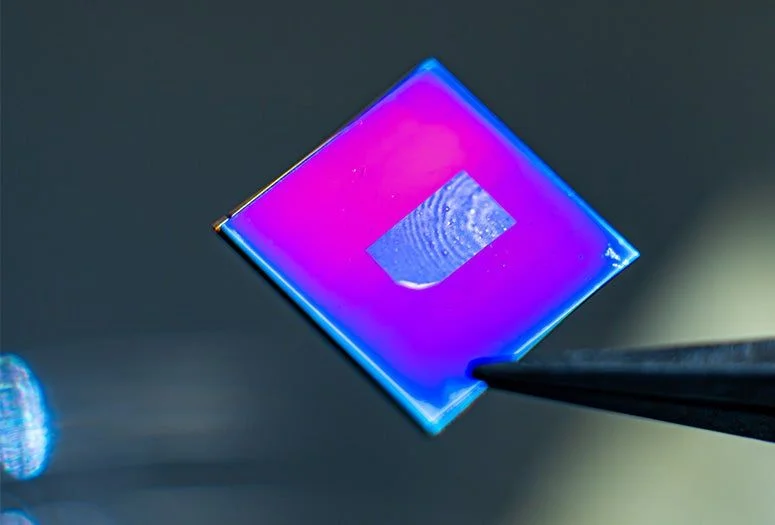
This enhanced efficiency stems from SHG, a nonlinear optical phenomenon where two light waves merge to form a single wave with double the frequency and half the wavelength. A practical implication is the conversion of invisible infrared light into visible light.

Implications and Future Directions
The flexibility of these nanotube films, alongside their optical prowess, suggests a broader range of applications beyond rigid materials. The research team anticipates further exploration into other nonlinear optical phenomena and the integration of these films into more complex photonic circuits.
The Chirality Conundrum
A significant hurdle in past research was the natural tendency for macroscopic carbon nanotube samples to contain an equal mix of left- and right-handed chiralities. This mixture caused their unique optical effects to cancel each other out, obscuring their potential. The recent work successfully overcomes this by creating ordered films.
Read More: OpenAI and Google Launch Tools to Spot AI Images in Paris
Materials: Chiral carbon nanotubes (CNTs)
Observed Effect: Second Harmonic Generation (SHG) – light frequency conversion
Key Advancement: Creation of large, highly ordered films of chiral CNTs
Performance: 2-3 orders of magnitude improvement over conventional materials
Potential Applications: Faster optical communications, flexible photonic chips, light-based computing
Publication: ACS Nano (DOI: 10.1021/acsnano.6c06017)
Institution: Rice University


