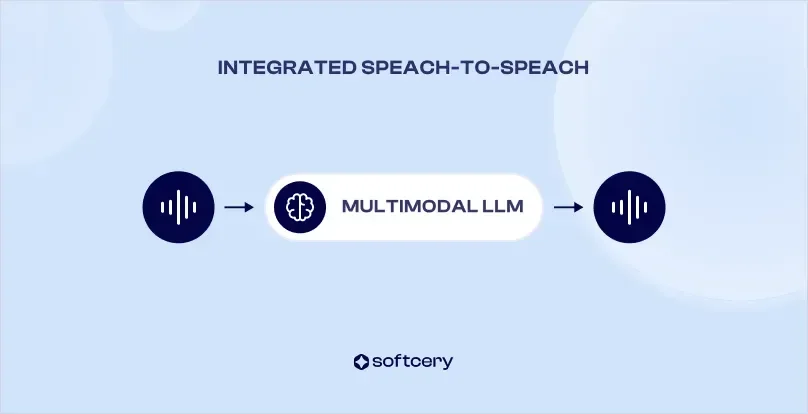
The operational heart of advanced voice AI is undergoing a profound recalibration, moving from segmented, turn-based processes towards a more fluid, 'speech-to-speech' paradigm. This evolution sidesteps the older, multi-stage pipeline of Speech-to-Text (STT) converting to a Large Language Model (LLM) for understanding, which then feeds into Text-to-Speech (TTS) for output. Instead, new architectures aim to process audio as a continuous flow, allowing for swifter, more integrated conversational exchanges.

Cascading Systems Give Way to Continuous Streams
Older voice AI designs relied on a sequential chaining: voice input would first be transformed into text (STT), this text would be processed by an LLM, and then the LLM's textual response would be converted back into audible speech (TTS). This architecture, while functional, introduced inherent delays.

Recent advancements, detailed in analyses from April 24, 2026, focus on 'speech-to-speech' agents.
These newer systems aim to merge raw audio input with textual reasoning and spoken output in a more unified manner.
Managing these continuous input and output streams presents a new frontier in orchestration for developers.
LLMs Injecting Nuance into Speech Synthesis
The capabilities of Large Language Models are also reshaping how artificial speech is generated. LLMs are pushing Text-to-Speech (TTS) beyond mere phonetic conversion into generating speech that is deeply aware of context and laden with expressive prosody.
Read More: Hana Bank Buys 6.55% Stake in Upbit Owner Dunamu for $670 Million

Traditional TTS systems involved steps like converting text to phonemes, predicting prosody, using acoustic models, and finally, a vocoder to produce audio.
Examples of these traditional neural TTS systems include combinations like Tacotron 2 with WaveGlow, or FastSpeech paired with HiFi-GAN.
LLM-powered TTS is described as evolving from simple voice generation towards more dynamic, intelligent vocal performances, as explored in technical dives published recently.
Joint models, such as OpenAI's GPT-4o, are seen as early indicators of 'end-to-end' architectures that directly translate prompts into voice.
OpenAI's Real-Time Models: A Leap in Latency and Functionality
OpenAI has recently rolled out new real-time voice models via its API, signaling a move towards more responsive and capable voice interactions.
Introduced on May 7, 2026, models like GPT-Realtime-2, GPT-Realtime-Translate, and GPT-Realtime-Whisper are now accessible through the 'Realtime API'.
GPT-Realtime-2 is noted as a significant upgrade, boasting 'GPT-5-class reasoning' that allows for more complex requests and sustained conversations.
GPT-Realtime-Translate offers live translation from over 70 input languages into 13 output languages, keeping pace with the speaker.
GPT-Realtime-Whisper functions as a streaming STT system, transcribing speech live as it is spoken.
These models are intended to enable developers to build voice experiences that are more natural, intelligent, and capable of real-time action.
Broader Trends: The Push for Speed, Privacy, and Scalability
The drive towards real-time voice AI is underpinned by several key technological and operational considerations.
Achieving ultra-fast response times without compromising voice quality remains a significant hurdle, as highlighted in a guide from early 2025.
Secure handling of voice data is also paramount, especially concerning data privacy and regulatory compliance.
To meet demand, solutions are leaning towards cloud-native architectures and edge deployments to ensure scalability for thousands of simultaneous sessions.
The development of LLM Voice frameworks aims to integrate speech understanding, generation, and multimodal dialogue into seamless, real-time spoken conversations.
Research into 'end-to-end models' that jointly train speech and text within a single architecture is ongoing, promising more efficient real-time speech-to-speech dialogue.
Background: The Shifting Landscape of Voice Interaction
The concept of voice AI has rapidly moved from a speculative notion to a practical, if still evolving, reality. Early demonstrations often showed impressive but limited functionality, struggling to translate effectively into real-world, high-demand scenarios. The architecture of these early systems typically involved distinct, sequential modules for speech recognition and synthesis, each with its own processing time. This segmented approach created bottlenecks, limiting the natural flow of conversation. The integration of LLMs, however, has begun to bridge the gap between raw linguistic processing and the more nuanced aspects of human communication, such as tone, emotion, and contextual understanding, directly influencing the output of TTS systems. The recent emphasis on real-time processing, particularly by major players like OpenAI, indicates a concerted effort to overcome the latency issues that have long plagued conversational AI, pushing towards applications that feel more immediate and human-like.
Read More: Siddharth Patwardhan AI Research Linked to Apple Siri