


Streamlining Game Performance Through Shaders and AI Integration
A recent, rapid consolidation of efforts between Nvidia and Microsoft aims to significantly improve the experience of PC gamers and developers. The core of this push involves altering how game shaders are handled, moving from runtime compilation to pre-delivery during game downloads. This change is directly linked to leveraging the ' hardware-accelerated AI ' capabilities present in Nvidia's ' RTX GPUs ', particularly the latest series. The goal is to directly address ' game stutters ' and reduce the frustrating delays associated with shader compilation, especially after game updates. This collaboration also standardizes the use of machine learning for graphics, such as in ' Nvidia DLSS ', to provide a smoother, more consistent user experience.
AI Development and PC Ecosystem Integration
Beyond gaming, the partnership is actively expanding the reach and utility of ' RTX AI PCs '. A key focus is on enhancing the development and deployment of artificial intelligence applications directly on these machines. This involves streamlining software tools and ensuring robust hardware support.
Read More: Harvard Engineers Create New Chip to Control Light's Spin
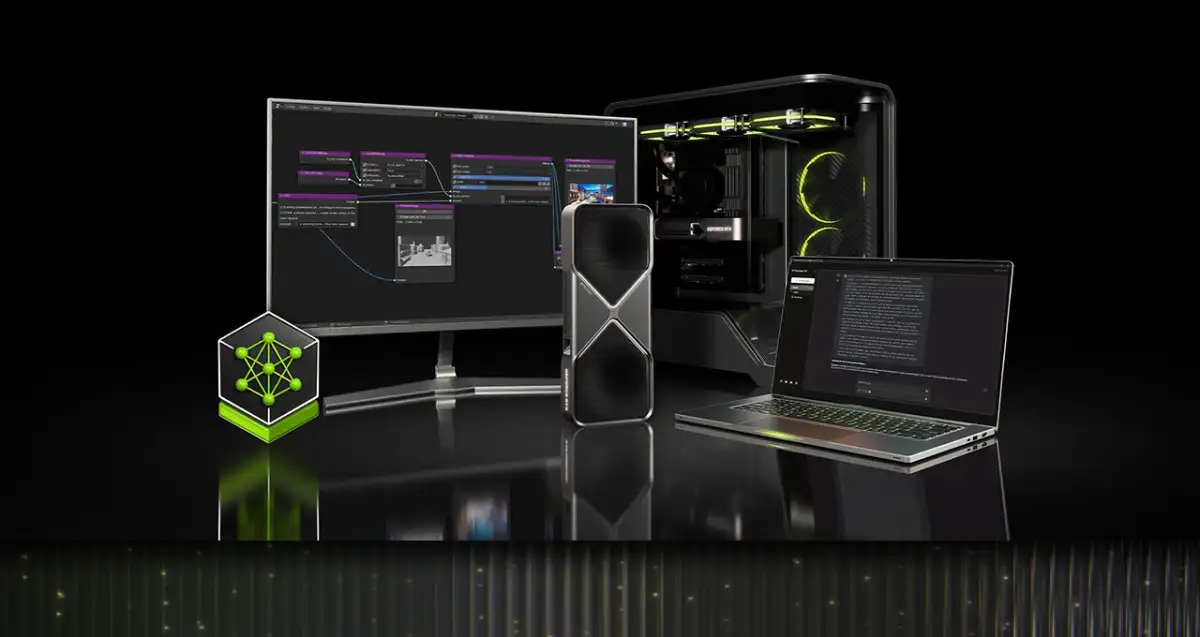
TensorRT Enhancements: Nvidia's ' TensorRT ', a platform for high-performance deep learning inference, has been redesigned for RTX AI PCs. This aims for a ' 8x smaller package size ', facilitating faster deployment of AI models.
Developer Accessibility: Efforts are underway to make Nvidia's suite of software development kits, including ' Nvidia DLSS ' and multimedia features like ' RTX Video ', more readily available for integrating advanced AI. Several major software developers are releasing updates to unlock AI capabilities specifically for RTX PCs.
Windows Integration: The integration of ' TensorRT for RTX ' with ' Windows ML ' is providing developers with broad hardware compatibility and improved execution efficiency. Furthermore, improved integration between ' Windows Subsystem for Linux (WSL) ' and Nvidia GPUs allows for seamless use of Linux-based AI development environments within Windows.
Cloud and Enterprise AI: The collaboration extends to cloud services, with ' Azure AI Foundry ' now offering ' Nvidia NIM microservices '. This initiative aims to empower businesses by accelerating AI innovation and maximizing ' GPU utilization ' within enterprise environments through platforms like ' Nvidia Run:ai on Azure '.
Broader Technological Advancements
The alliance is also exploring more cutting-edge graphical technologies, particularly within game development engines.
Neural Shading Technology: Advances in ' Nvidia RTX neural rendering technologies ' are being introduced, with ' RTX Mega Geometry ' becoming available to developers via the ' Nvidia RTX (NvRTX) branch of Unreal Engine 5 '.
Enhanced Game Demos: A ' playable Half-Life 2 RTX demo ' is slated to showcase these advancements, including full ray tracing, ' Nvidia DLSS 4 Multi Frame Generation ', and other neural rendering enhancements.
Background and Context
This deepening partnership between Nvidia and Microsoft signals a strategic move to capitalize on the burgeoning fields of AI and advanced graphics. By combining Nvidia's hardware and AI software expertise with Microsoft's extensive operating system and cloud infrastructure, the companies are working to create a more unified and efficient ecosystem for both consumers and developers. This includes efforts to improve the performance and accessibility of AI on personal computers, a trend that is rapidly transforming software experiences from creative tools to everyday applications. The push also aims to integrate AI more deeply into gaming, promising smoother gameplay and richer visual experiences.
Read More: New $2,500 Gaming PC Builds in 2025 Cost More for High Graphics