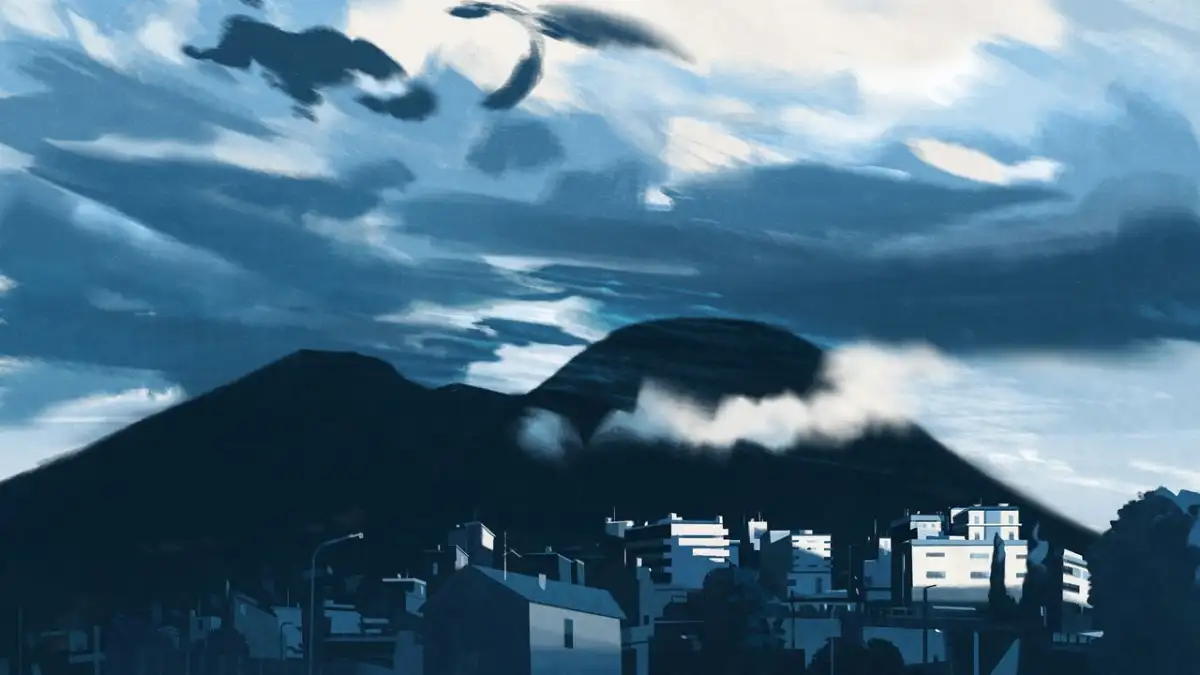
NAPLES, ITALY - The veil of Mount Vesuvius hangs heavy over Naples, a constant hum beneath the surface of everyday life. Director Gianfranco Rosi's new film, 'Pompei: Below the Clouds,' attempts to capture this persistent undercurrent, focusing on the city's unique, uneasy coexistence with its geological destiny. The documentary, shot over three years, delves into how the past is not a separate entity but an ever-present force, shaping the lives of those who inhabit the land directly beneath the slumbering giant.
The film's central theme revolves around the permeability of history in Naples, where the remnants of ancient destruction and the threat of future upheaval are woven into the fabric of contemporary existence. Rosi, known for his immersive documentaries, employs luminous black-and-white cinematography, rendering Naples in a soft, almost ethereal light, a stark contrast to the potential violence of Vesuvius. This visual approach underscores the fragility and resilience of the city and its inhabitants.
A Symphony of Unseen Connections
'Pompei: Below the Clouds' doesn't follow a linear narrative but rather weaves together a tapestry of disparate lives and experiences. It features characters such as a museum curator who speaks to ancient statues as if they were present companions, underscoring the tangibility of history for some. Other narratives touch upon law enforcement, students, and those who work to preserve the city's underground heritage. The film highlights individuals acting as 'stewards' of this connection to the past, whether through historical preservation, academic study, or simply by living with the constant awareness of Vesuvius's power.
Read More: Sayeeda Ali painting workshop in Visakhapatnam on July 4 2026
Rosi himself describes his filmmaking process as an encounter with a place, a hunt for what exists beyond the immediate frame. He utilizes an empty movie theater, projecting archival footage of Pompeii and Vesuvius onto its screen, as a recurring motif. This technique serves to interrogate cinema itself as an archival object, questioning how we consume and understand history through moving images. The filmmaker’s approach is described as creating a "city symphony," where the perceived reality of Naples is always incomplete, hinting at an immense urban life just outside the lens.
The film premiered at the Venice Film Festival, where it garnered critical attention and awards, including a Special Jury Prize. It has since been showcased at numerous international festivals, solidifying Rosi's reputation as a filmmaker adept at capturing the intimate and the planetary. 'Pompei: Below the Clouds' is set for a theatrical release across the United States beginning March 13th, with showings starting earlier in New York on March 6th. It will also be available on the streaming platform MUBI.
Read More: AC Milan transfer news April 2026 Ruben Amorim targets new players
Background: The Weight of Vesuvius
Mount Vesuvius, the volcano overlooking the densely populated region of Campania, is infamous for its catastrophic eruption in 79 AD, which buried the Roman cities of Pompeii and Herculaneum under volcanic ash and pumice. This event, while a destructive tragedy, has preserved these ancient sites in remarkable detail, offering an unparalleled window into Roman life. The volcano remains active, and its proximity to modern cities like Naples creates a persistent, if often unspoken, sense of potential danger and historical weight.
Gianfranco Rosi is an acclaimed documentary filmmaker, celebrated for his patient, observational style. His previous works include 'Sacro GRA,' which won the Golden Lion at the Venice Film Festival, and 'Fire at Sea,' a Golden Bear recipient at the Berlin International Film Festival, both lauded for their profound humanism and distinctive visual language. 'Pompei: Below the Clouds' continues his exploration of places grappling with complex societal and environmental pressures.
Read More: Actress Philippa Dunne Faces Audience 'Disgusting' Review