


The machinery of survival in the Middle East is now a declared target. As the conflict involving Iran, Israel, and the United States shifts away from the predictable rhythms of oil and gas, the focus has landed on the brittle infrastructure of human hydration. Within the last 24 hours, the safety of the region’s desalination plants has collapsed, turning seawater conversion into a tactical vulnerability.
"The ongoing conflict in West Asia is entering a new phase as desalination plants… begin to emerge as targets in the widening confrontation."
Iran officially accuses the United States of an aerial strike on a freshwater facility on Qeshm Island.
In the UAE, damage has been reported near the Fujairah F-1 integrated power and water plant.
Bahrain authorities state a domestic water plant was hit, while Kuwait faces reports of incidents near the Doha West desalination site.
Saudi Arabia confirmed its Defense Ministry intercepted a drone targeting the massive Shaybah oil field, indicating that while water is the new target, energy remains in the crosshairs.
The Fragile Math of Coastal Survival
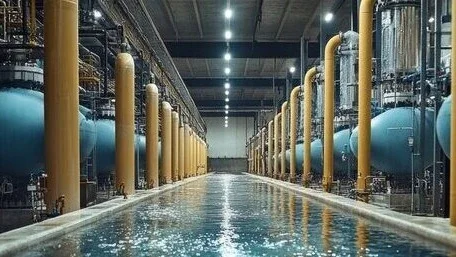
The Gulf states—Saudi Arabia, the UAE, Qatar, Bahrain, Oman, and Kuwait—exist in a state of artificial moisture. These nations rely on massive, energy-hungry industrial complexes to pull salt from the sea. Because water and power are often produced in the same "co-generation" facilities, a single strike on an electrical turbine can effectively shut off the taps for an entire city.
| Nation | Key Plant | Estimated Capacity (m³/day) |
|---|---|---|
| Qatar | Umm Al Houl | 620,500 |
| Qatar | Ras Abu Fontas | 500,000+ |
| Kuwait | Az-Zour North | 486,000 |
| Kuwait | Doha East/West | 970,000 (Combined) |
| Oman | Barka / Al Ghubrah | 300,000 (Each) |
| Bahrain | Al Hidd | 270,000 |
The Mechanics of Vulnerability
The shift toward water infrastructure marks a transition to asymmetric cruelty. Unlike oil, which affects global markets and bank accounts, water shortages impact the immediate biological survival of local populations.
Read More: Russia Shares US Military Locations with Iran, Affecting Middle East Safety
These plants are clunky, static targets that cannot be moved or hidden.
The dependency of Gulf cities on these systems is absolute; there are no rivers to fall back on.
Damage to membrane-based or thermal technologies requires specialized parts and long repair times, making even a "minor" strike a long-term disaster.
Background: A Tangled Succession
The escalation coincides with a rigid shift in Iranian internal politics. Iran has reportedly named Mojtaba Khamenei to succeed his father as the Supreme Leader. This internal transition occurs as the Revolutionary Guard and Hezbollah signal continued support for widening the strike zone to civilian lifelines.
Israel's offensive, which began following Hezbollah rocket fire, has now expanded into a broader map of critical infrastructure. What was once a war of ideology and territory has become a war of attrition against the basic requirements for life in the desert. If the current trajectory of targeting desalination plants continues, the regional geography will revert to its original state: a place where humans cannot stay for long.