

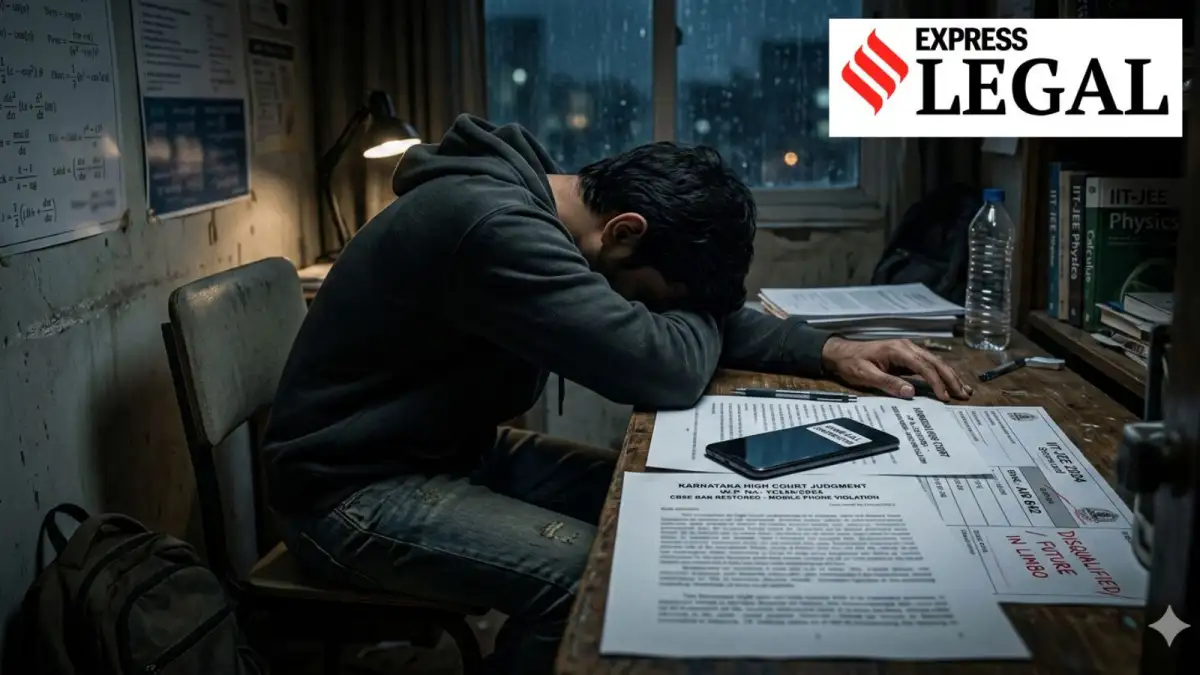
The Karnataka High Court, in a significant decision, has reinforced the Central Board of Secondary Education's (CBSE) stringent stance against examination malpractices. The court has upheld the board's decision to cancel all examinations for a Class 12 student and debar him from taking exams for two academic years, following the discovery of a mobile phone in his possession within the examination hall. This ruling comes after a single-judge bench had initially provided some relief to the student.

The High Court’s division bench affirmed that the mere possession of a mobile phone inside an examination hall constitutes "unfair means" under the CBSE's revised guidelines. This stance makes the actual use or non-use of the device for cheating irrelevant to the penalty, establishing a clear precedent for the strict enforcement of examination protocols. The court emphasized that academic policies of expert bodies should not be diluted unless they are manifestly arbitrary.

The student, who had apparently carried the mobile phone into the hall on the first day of his exams for the Physical Education paper, was found with the device about 25 minutes after the examination began. Despite claiming he had entered the hall inadvertently, the invigilator reported the incident. Following this, the CBSE’s Unfair Means (UFM) Committee investigated, leading to the cancellation of all his examinations for that year and a two-year debarment. This penalty falls under Category-3 of the CBSE's UFM rules, which prescribes stringent punishment.

Interestingly, the student had scored 92% in his Class 10 CBSE examinations and had also qualified for the JEE-Advanced Examination. The initial single-judge ruling had quashed the CBSE's punishment and directed the board to declare the student's results. However, the CBSE appealed this decision, arguing that it undermined their examination protocols. The division bench's restoration of the original penalty signifies a victory for the board's efforts to maintain academic integrity.
Read More: High Court Acquits Dera Chief in 2002 Journalist Murder Case

The CBSE’s revised guidelines, particularly those issued on January 20, 2025, explicitly place the possession of mobile phones within examination centres under Category-3. This amendment contrasts with earlier guidelines where such possession might have been viewed with relatively less severity under Category-1. The current penalty, as upheld by the court, involves the cancellation of examinations in all subjects for the current and subsequent academic years. The court’s reliance on previous judicial pronouncements, such as Shuchi Mishra v. The Governing Body, further solidifies the legal basis for its decision.