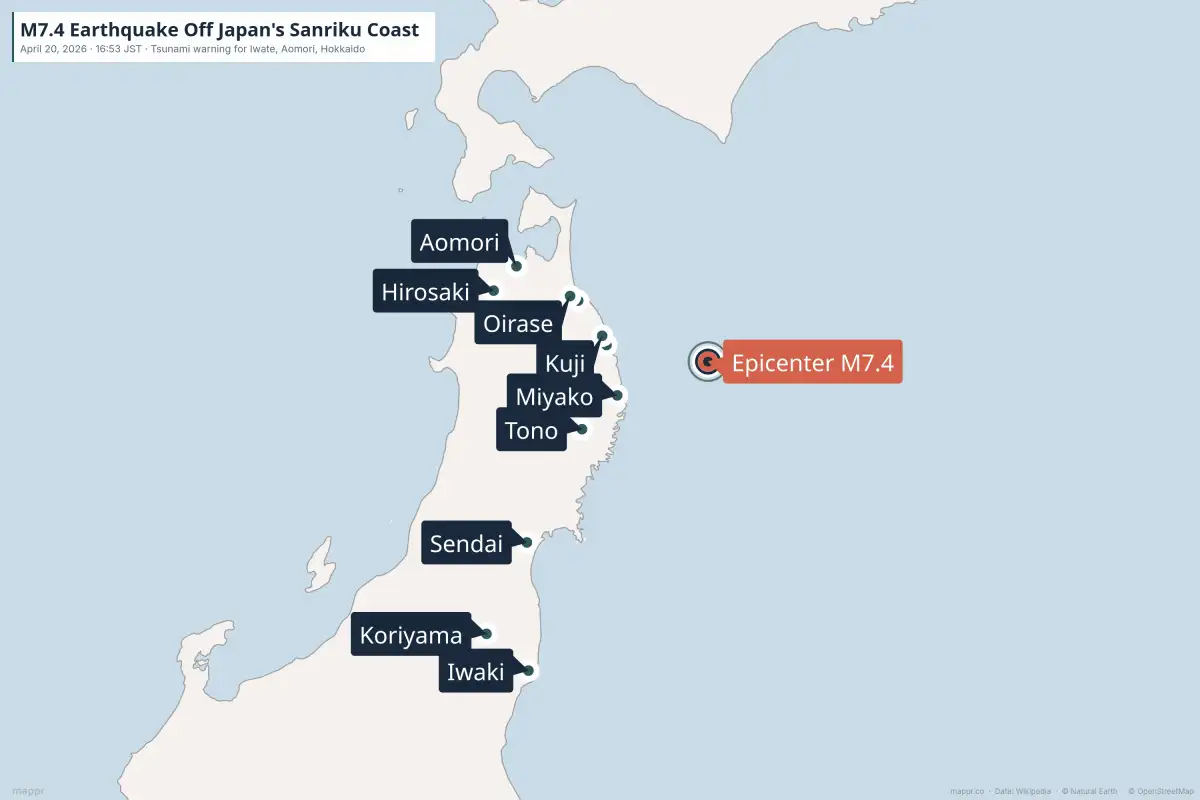
TOKYO – A significant earthquake, registering 7.7 magnitude according to the Japan Meteorological Agency (JMA) and 7.4 magnitude according to the US Geological Survey (USGS), struck off Japan's northeastern coast on Monday, triggering tsunami warnings and subsequent advisories that have since been lifted. Authorities have warned of a heightened risk for a larger, "megaquake" in the coming days, urging vigilance across coastal regions.
The tremor, occurring at a depth of 19 kilometers (JMA) or 35 kilometers (USGS) beneath the Pacific Ocean floor, prompted immediate tsunami alerts. Initial warnings for waves up to three meters were issued for prefectures including Iwate, Hokkaido, and Aomori.
Waves measuring up to 80 centimeters were observed at Kuji Port in Iwate Prefecture, with smaller waves recorded in Miyako, Urakawa, Hachinohe, and Erimo. Thousands of people, estimated at over 170,000, were advised or ordered to evacuate coastal areas. The Tōhoku Shinkansen high-speed rail line experienced overnight suspensions but has since resumed operations.
Read More: Minor Earthquakes Felt Across US West Coast States on June 5
Elevated Megaquake Risk Prompts Public Advisory
Following the main event, the JMA issued a special advisory, indicating an elevated risk of a magnitude 8.0 or stronger earthquake. Officials stress this is not a prediction but a caution for residents in 182 towns along the northeastern coasts to increase preparedness while maintaining daily routines. Prime Minister Sanae Takaichi has urged residents in affected zones to move to higher ground. This advisory comes amid concerns that stress changes along the Japan Trench could precipitate a larger seismic event, although the JMA has calculated a 1 percent chance of such a quake in the immediate hours or days. A similar advisory was issued after a 7.5-magnitude quake in December, but no subsequent megaquake materialized.
Geological Context and Tsunami Impact
The earthquake's epicenter was located approximately 100 kilometers off Miyako, Iwate Prefecture. This region is geologically significant, situated where the Pacific tectonic plate subducts beneath the North American plate at the deep-sea Japan Trench. While tsunami warnings were downgraded to advisories and eventually lifted, the initial alerts created widespread disruption. Authorities are closely monitoring seismic activity for potential aftershocks and further geological shifts.
Read More: Junji Ito Live-Action TV Shows Replace Anime on April 7 2026