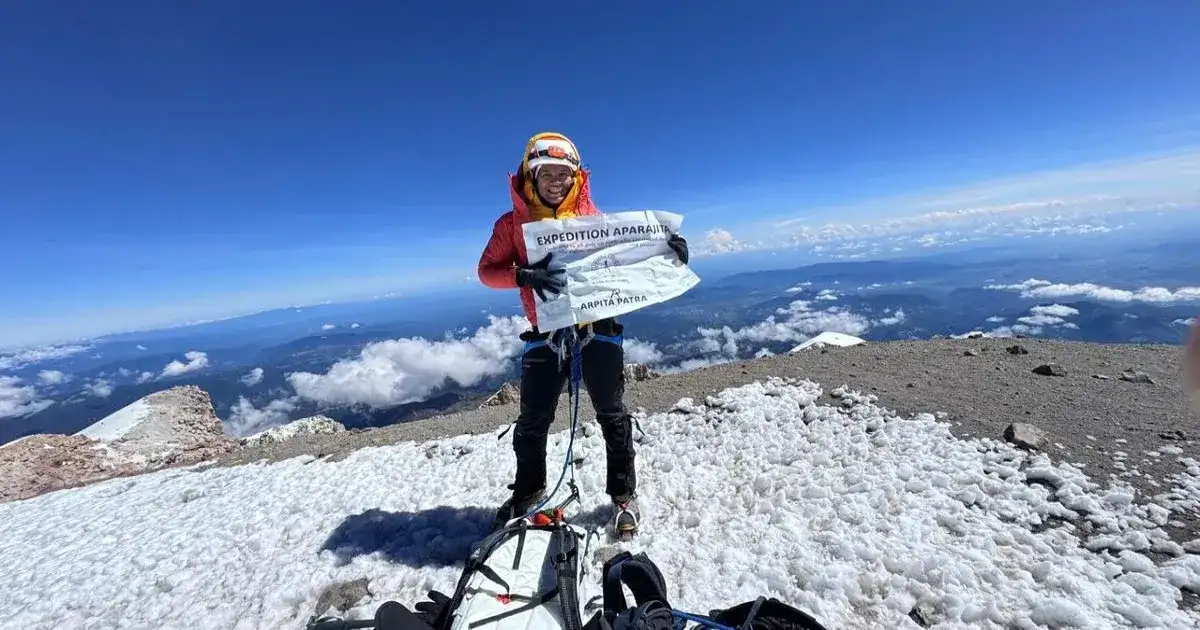
Arpita Patra, a faculty member at the Indian Institute of Science (IISc), recently reached the summit of Nevado Ojos del Salado in Chile, documented as the highest volcanic peak on the planet. Standing at approximately 6,893 meters, the mountain marks a specific point in Patra’s project to scale the ' Volcanic Seven Summits '. She occupies a role in the Department of Computer Science and Automation, splitting her time between abstract data and the physical resistance of high-altitude rock.

The ascent of Ojos del Salado concluded with a 50-meter vertical rock-climbing segment, a technical requirement that follows days of thin air and freezing winds. Patra is now cited as the second Indian woman to reach this specific Chilean summit. Her timeline for the remaining two peaks is set for completion by 2026.
Read More: Indigenous Data Rights Now Key in Conservation Genomics

Technical Logistics and Physical Data
The process of climbing these peaks is less about "conquest" and more about the management of biology against steep inclines. On the northern face of Pico de Orizaba in Mexico, the ascent involved a 1,450-meter elevation gain in a single day, moving from 4,200 meters to the 5,636-meter peak via the Jamapa Glacier.

"Balancing these two seemingly orthogonal pursuits, rigorous academic research and high-altitude mountaineering, has been both challenging and deeply fulfilling," Patra noted regarding her dual life at IISc Bengaluru.
| Volcanic Peak | Elevation (m) | Location | Significance |
|---|---|---|---|
| Nevado Ojos del Salado | 6,893 | Chile/Argentina | World's highest volcano |
| Pico de Orizaba | 5,636 | Mexico | Highest in North America |
| Mt. Kilimanjaro | 5,895 | Tanzania | Highest in Africa |
| Mt. Elbrus | 5,642 | Russia | Highest in Europe |
| Mt. Giluwe | 4,367 | Papua New Guinea | Highest in Oceania |
Patra’s path relies on a mix of independent training and the procurement of ' logistical support ' from professional trekking companies abroad. This institutional and commercial scaffolding allows for the movement across ' Jamapa Glacier ', a route known for 30-40 degree snow slopes where crampons and ice axes are mandatory for survival.

The Training Architecture
The transition from a laboratory to a glacier requires a specific type of ' endurance survival '.
Patra underwent a 21-day basic mountaineering course at the National Institute of Mountaineering and Adventure Sports (NIMAS).
Physical readiness was tested through the Ladakh Half Marathon, a race conducted at an altitude of 3,500 meters.
Her previous activity includes being the first Indian woman to reach the top of Mount Wilhelm, the highest point in Papua New Guinea.
The jagged nature of this pursuit involves navigating "technical rock-climbing" and "glacial terrain" while maintaining the ' academic precision ' required by the Indian Institute of Science.
Read More: 89-Year-Old Doctor Aims for Kilimanjaro Summit on 90th Birthday
Background on Institutional Inspiration
In the closed environment of the IISc, Patra’s deviations into the physical world are viewed by peers as an extension of professional stamina. She is often compared to colleagues like Prof. G. Madhavi Latha, who contributed to the structural engineering of the Chenab Railway Bridge.
The pursuit of the Volcanic Seven Summits is a niche goal in mountaineering, focusing specifically on the highest volcanoes on each continent rather than just the highest tectonic peaks. While ' Arpita Patra ' continues her tenure in computer science, her schedule remains dictated by the 2026 deadline to finish the remaining two summits of the global circuit.