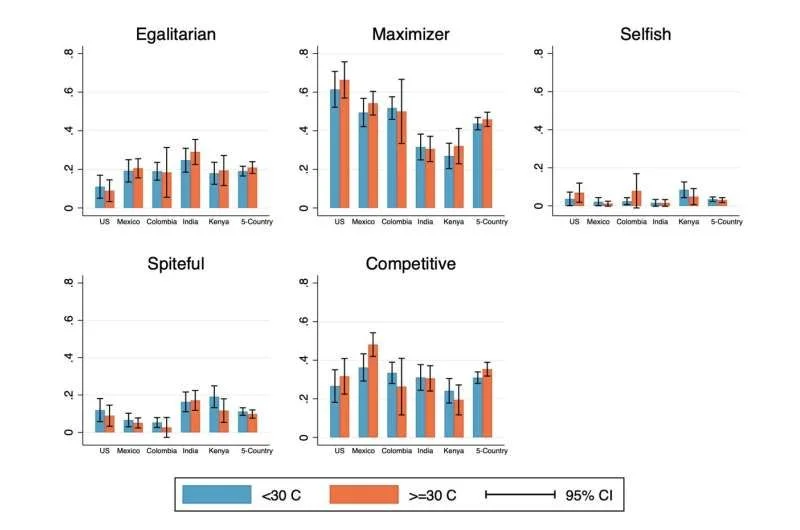
New findings published in PNAS Nexus challenge the long-held assumption that rising ambient heat directly correlates with a collapse in human cooperation. While environmental conditions undeniably impact internal states—such as mood, fatigue, and frustration—the research indicates these emotional shifts do not translate into predictable changes in economic behavior, altruism, or spite.

High-temperature environments do not inherently trigger selfishness or diminish prosocial decision-making in controlled economic scenarios.

Experimental Parameters
Led by Alessandra Cassar, researchers engaged university students across five nations (Colombia, India, Kenya, Mexico, and the United States) to participate in structured economic games. The setup contrasted moderate room temperatures (18°C) against high-stress thermal conditions (34°C).

| Metric | Findings in Heat (30°C+) |
|---|---|
| Mood/Wellbeing | Significant increase in reported frustration/fatigue |
| Egalitarianism | No systematic change |
| Competitiveness | No systematic change |
| Selfishness | No systematic change |
The Gender and Cultural Variable
While the thermometer failed to predict shifts in social behavior, other factors emerged as stronger indicators of individual action:

Gender Divergence: Across all tested regions, female participants exhibited higher rates of egalitarianism compared to their male counterparts.
Competitive Gap: With the notable exception of Kenya, women consistently demonstrated lower levels of competitiveness than men.
Cultural Context: National identity, particularly in the United States, surfaced as a meaningful filter for how individuals weigh equal outcomes against personal gain.
Investigative Perspective: Understanding the Disconnect
The study serves as a necessary check on environmental determinism—the tendency to attribute complex social friction entirely to climate stressors.
Read More: Politics Over Qualifications: New Study Shows Trust Based on Beliefs
While historical patterns link rising temperatures to societal-level aggression, these researchers posit that such phenomena are likely driven by indirect mechanisms rather than a direct physiological erosion of human morality. Factors like crop failure, economic strain, or increased alcohol consumption may act as the true catalysts for instability.
The human capacity for decision-making appears, at least within these experimental boundaries, to remain resilient even as physical comfort wanes. The Social-Psychology evidence suggests that deeply embedded cultural and gendered norms dictate Prosociality far more than the simple movement of a mercury column. The myth that heat itself creates a more selfish animal is not supported by these results.