

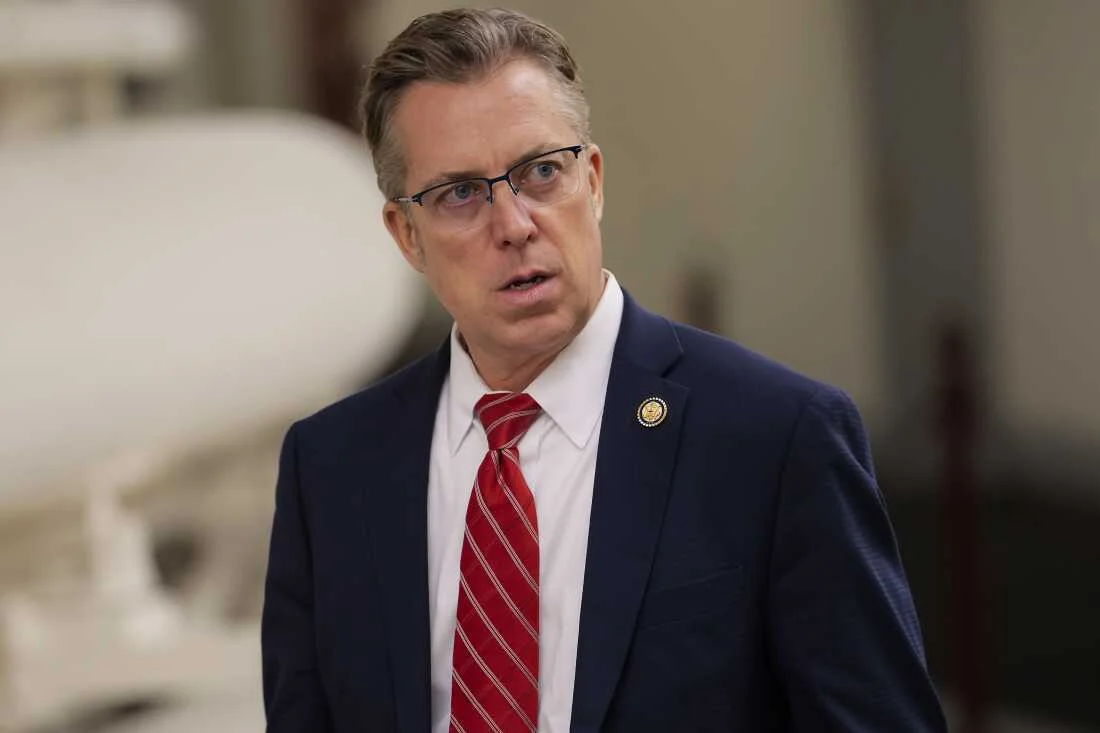
CONTROVERSIAL STATEMENT IGNITES FIRECRACKER OF REACTION
Representative Andy Ogles, a Republican from Tennessee, has ignited a firestorm with his pronouncement on social media that "Muslims don't belong in American society." The statement, made on March 9th, surfaced on the heels of alleged bomb-making attempts in New York City, which authorities are probing as an "act of ISIS-inspired terrorism." Ogles' words have drawn swift and sharp condemnation from Democrats, though public remarks from his Republican colleagues have been notably muted.
Ogles' assertion, delivered via the platform X (formerly Twitter), directly challenges the foundational ideals of religious freedom upon which the United States was purportedly established. This declaration arrives at a politically charged moment, coinciding with the House Republicans' annual policy retreat and amidst escalating conflict in Iran.

The pronouncements echo a broader trend within some factions of the House Republican party, where instances of anti-Muslim rhetoric have become increasingly visible. Ogles himself has a prior history of contentious remarks, including previously calling for the stripping of citizenship and deportation for Eric Adams, New York City's first Muslim mayor.
Read More: JD Vance's August 2024 Anti-Draft Comments Gain Attention Amid Trump Administration Speculation
BROADER RIPPLES AND SILENT SUPPORT
The Council on American-Islamic Relations, a civil rights advocacy group for Muslim Americans, has been particularly vocal in its denunciation. They have highlighted what they perceive as a stark double standard, pointing out that while Muslim members of Congress have faced censure for criticizing Israeli actions in Gaza, figures like Ogles, and other lawmakers such as Randy Fine, have seemingly operated without consequence for their "dangerous rhetoric."
"Yet anti-Muslim extremists in Congress like Randy Fine and Andy Ogles have faced no consequences for their dangerous rhetoric even as American Muslim members of Congress have faced censure motions, threats and harassment for daring to criticize Israel's genocide in Gaza. The double-standards and hypocrisy must end."
While some Democrats, such as Representative Eric Swalwell of California, have publicly rebuked Ogles' statement, framing it as un-American, the broader Republican response has been largely absent. Requests for comment directed at Ogles' office and House Speaker Mike Johnson have, as of this report, gone unanswered. However, not all within the GOP have remained silent; Richard Grenell, a former envoy under President Trump, has been noted as one of the few Republicans to publicly criticize Ogles' post.
Read More: US Customs Promises Tariff Refund System in 45 Days But Payout Date Unclear
Ogles' district, which includes Nashville, is home to a significant Muslim population in the American South, a fact that lends an additional layer of gravity to his pronouncements. The Congressman's comments appear to have emboldened other voices on the right, suggesting a potential solidification of anti-Muslim sentiment within certain political circles.
HISTORICAL ECHOES AND POLITICAL CURRENTS
This episode is not an isolated incident but rather a symptom of ongoing debates and tensions surrounding immigration, national identity, and religious freedom in the United States. The country's historical narrative is frequently invoked in discussions about inclusivity and belonging, with competing interpretations of what it truly means to be "American." The rise of anti-immigrant and nationalist sentiments in recent years has, for some, created an environment where such exclusionary rhetoric can gain traction. The linkage drawn by Ogles between the actions of alleged extremists and an entire religious group taps into historical patterns of scapegoating and collective punishment.
Read More: Supreme Court Orders New Tribunals for West Bengal Voter List Changes