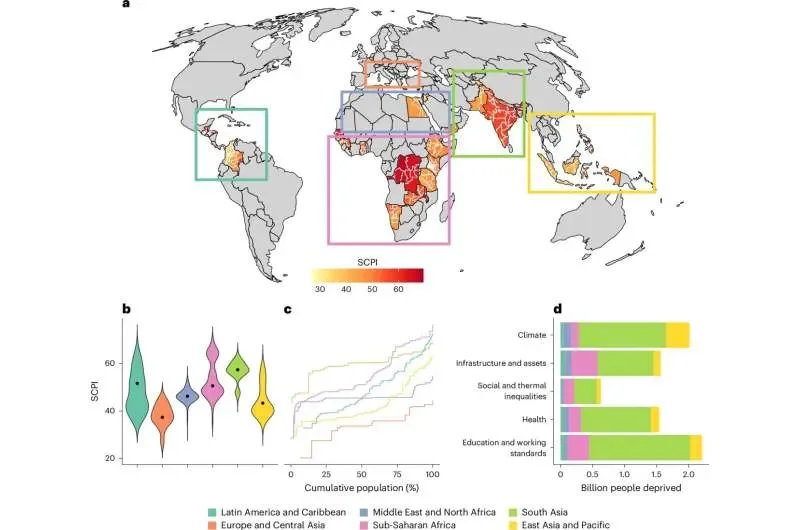
A new study published in Nature Sustainability asserts that heat-related human risk is disconnected from mere temperature data. Researchers have formalized the concept of Systemic Cooling Poverty (SCP), a measurement framework that exposes how structural deprivation—not just climate change—creates fatal thermal environments.
The core finding identifies that physiological limits are being reached not only in regions with extreme heat, but in areas with deep infrastructural, social, and institutional instability.
The Five Dimensions of Cooling Poverty
The study replaces traditional reliance on air-conditioning access with a multidimensional index:
| Dimension | Scope of Impact |
|---|---|
| Climate Exposure | Frequency of localized heat events |
| Infrastructure & Assets | Housing quality, power grid stability |
| Social/Thermal Inequalities | Economic status, community support systems |
| Health Status | Pre-existing physiological vulnerabilities |
| Work/Education Standards | Safety protocols in labor and learning environments |
This index shifts the burden of proof from "weather events" to "systemic failure."
Countries such as Ethiopia and the Democratic Republic of Congo emerge as high-risk zones, even when their ambient temperatures are lower than those of desert regions, due to the total absence of coping mechanisms.
The Failure of Predictive Models
The emergence of this mapping arrives alongside a broader crisis in climate forecasting. Existing models are currently failing to account for "grey swan" heatwave hotspots that are warming significantly faster than average seasonal trends.
Global models have consistently underestimated the rate at which peak heat extremes occur, compared to steady annual averages.
The United States Southwest and California serve as localized examples of this discrepancy, where extreme spikes have defied earlier simulations.
Paradoxically, other regions—such as parts of Siberia, Northern Africa, and sections of the north-central U.S.—are seeing peak temperatures remain lower than projected models, creating a disjointed global picture.
Investigation: The ‘Grey Swan’ Reality
The reliance on global mean temperature increases as a primary indicator for human safety is becoming increasingly obsolete. While wealthier nations often possess the technical assets to mitigate thermal shocks, the cumulative human toll from extreme heat continues to outpace all other Weather-related fatalities, including hurricanes and floods.
Read More: India IVF Costs And Social Barriers Limit Access In April 2026
The Systemic Cooling Poverty framework posits that without institutional reform, technological solutions like individual air conditioning act merely as stopgaps in a crumbling landscape. As these hotspots become more frequent and unpredictable, the Intersecting deprivations identified by researchers—ranging from inadequate housing to labor exploitation—remain the primary determinants of whether an heatwave becomes a disaster.