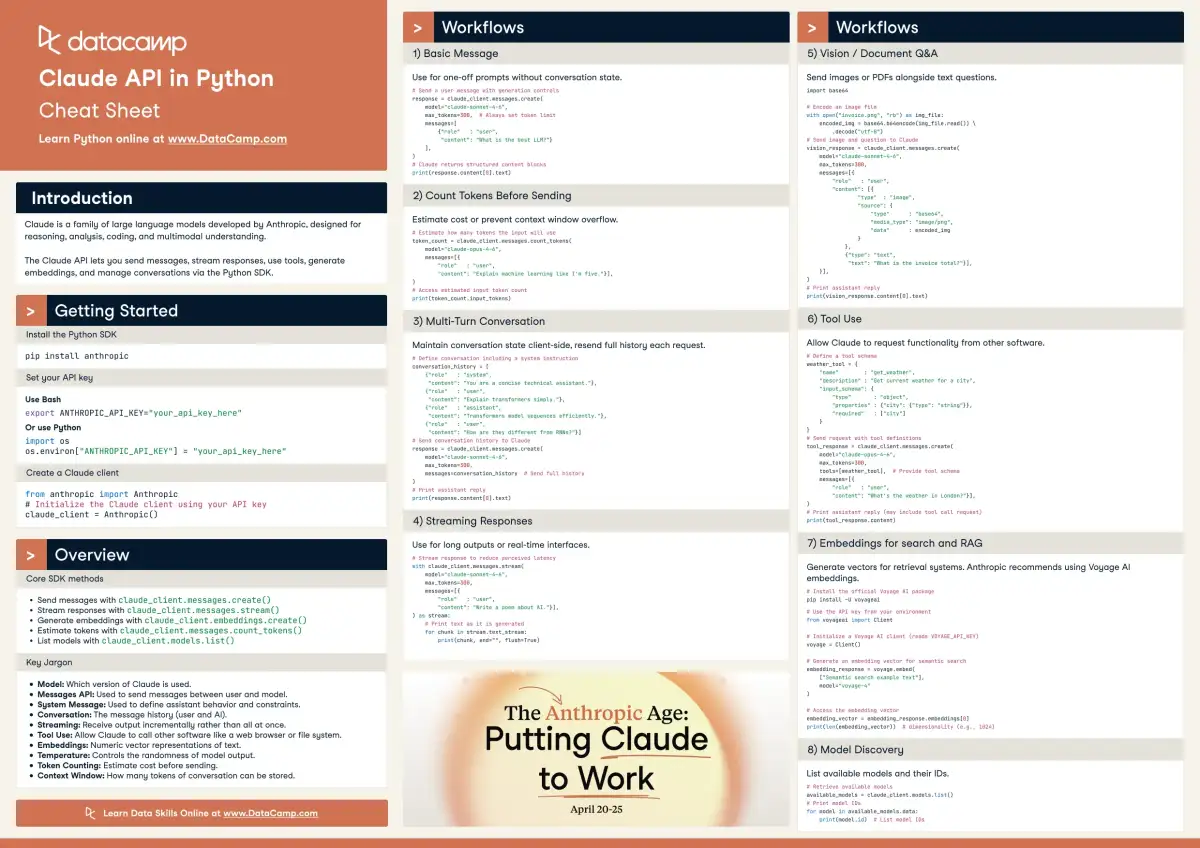
Current technical documentation across 2026 developer resources confirms that integration of the Anthropic anthropic Python SDK has stabilized around a standard client-server message loop. Developers seeking to deploy Claude models—primarily the Haiku, Sonnet, and Opus series—must manage a stateful messages list to maintain conversation context, as the API remains fundamentally stateless.
Core integration requires passing a model ID, a max_tokens constraint, and a messages list structure to the client.messages.create() method.
Technical Implementation Pillars
The standard workflow for modern Python applications, as observed in recent implementations, relies on these mechanisms:
State Management: Since the API does not store conversation history, developers are responsible for appending alternating
userandassistantroles to a local list object.Token Management: The
max_tokensparameter is a mandatory, hard limit. Production-grade scripts must implement history truncation (e.g., keeping only the last 20 turns) to prevent exceeding model context windows and incurring unnecessary costs.Streaming & Asynchronous Operations: To reduce perceived latency in user-facing applications, the
client.messages.stream()method is utilized for character-by-character output. For backend environments like FastAPI, developers are switching toAsyncAnthropicto handle concurrent connections via non-blocking I/O.Resiliency Patterns: Because the API is prone to
RateLimitErrorand transient network failures, production code now embeds exponential backoff logic and standardtry-exceptblocks to automate retries.
| Feature | Standard Implementation |
|---|---|
| Basic Call | client.messages.create() |
| Latency Mitigation | client.messages.stream() |
| Tooling/Agents | tool_use (Stop-reason loop) |
| Environment Security | python-dotenv for API key masking |
The "Tool Use" Paradigm
The shift toward agentic behavior is anchored in the tool_use functionality. Developers define local Python functions and expose their signatures to Claude. The control flow requires the application to inspect the stop_reason of a response; if it returns tool_use, the client executes the local function, feeds the result back to the model, and loops until an end_turn signal is received.
Read More: Chrome mimeHandler API lets extensions handle file types
Development Context
The reliance on Claude API integrations has evolved rapidly through early 2026. The documentation highlights a divergence between "prototyping" (where cost-efficient models like claude-haiku are preferred) and "complex reasoning" (reserved for claude-opus).
Observation: Current best practices emphasize the explicit removal of proxy environment variables (
HTTP_PROXY,HTTPS_PROXY) to avoid SSL handshake conflicts when interacting with the Anthropic endpoints.Warning: Security standards explicitly forbid committing
ANTHROPIC_API_KEYto version control, necessitating the use of.envfiles paired with.gitignoreconfigurations.