


The industrial and domestic production of the Caramel-Coated Orange Flan relies on the specific thermal degradation of sucrose and the coagulation of avian proteins. Data across multiple culinary records indicate a cooking window between 45 minutes and 1 hour 20 minutes, requiring a baseline of egg-milk emulsion stabilized by citrus acidity.
"Measure precisely the sugar for the cream and for the caramelized [part to] avoid bitterness or burnt sugar." — General procedural logic.
The fundamental architecture of the dish remains consistent despite variations in dairy density:
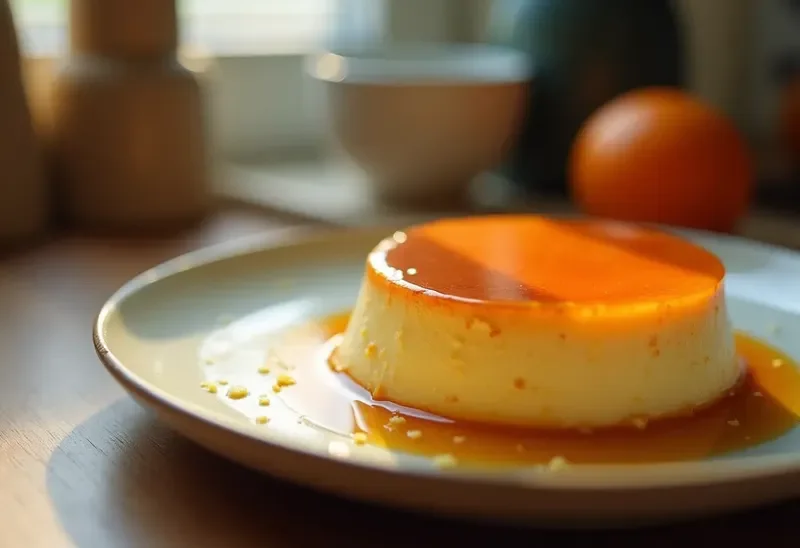
Liquid Phase: Milk is heated to a boil, often infused with orange zest to extract essential oils, then cooled to prevent premature egg curdling.
Structural Matrix: A mixture of whole eggs or yolks and sugar serves as the binding agent; some protocols introduce Maïzena or condensed milk to alter the final viscosity.
Carbon Layer: Dry sugar or sugar-water solutions are heated until they reach a caramelized state, then used to line the interior of the mold before the custard is added.
Methodological Divergence
While the core components are static, the assembly methods reveal a lack of consensus on texture and "mouthfeel."
| Component | Standard Approach | Industrial Variation |
|---|---|---|
| Dairy | Whole milk/Cream | Condensed milk |
| Orange | Zest infusion | Juice + Slices |
| Thickener | Egg coagulation | Cornstarch (Maïzena) |
| Refinement | Direct pour | Sieving (Tamis) |
The use of a sieve (tamis) ensures a uniform texture by removing air bubbles and undissolved protein strands.
Technical Nuance and Failure Points
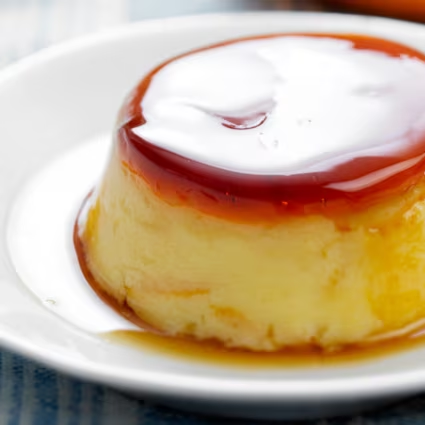
Success in this specific chemical arrangement is dictated by the exclusion of the albedo (the white, bitter part of the orange peel). Documentation suggests that buttering the molds facilitates the physical release of the dessert, which is otherwise prone to structural collapse during the inversion process.
The thermal environment must be monitored; high-heat baking risks a "rubbery" texture.
Cooling periods are non-negotiable for protein setting, with some records suggesting up to 7 hours for complex variations like coconut-based flans.
Background: The Ubiquity of the "Easy" Dessert
The "flan" exists as a low-cost, high-yield commodity in Western domesticity. Labeled consistently as bon marché (cheap) and très facile (very easy), it occupies a space where simple ingredients—sugar, eggs, milk—are transformed through basic physics. The addition of orange serves as a common aromatic intervention to mask the sulfurous scent of cooked eggs, a frequent critique of unflavored custards. Most contemporary iterations now suggest serving with a vanilla ice cream buffer or fresh orange slices to provide a temperature and acidity contrast to the sugar-heavy base.