The Bharatiya Janata Party (BJP) has solidified its claim on power in West Bengal, securing 207 seats in the 294-member assembly. This tally, finalized after a recount victory in the Rajarhat-New Town constituency, marks a decisive end to the Trinamool Congress's (TMC) 15-year governance. The results represent a significant political upheaval, ushering in the BJP's first-ever government in the state. The TMC, by contrast, has been reduced to 80 seats.
The outcome is framed by supporters as a victory for nationalist forces and a rejection of the incumbent government. Union Minister Ashwini Vaishnaw declared, "Fear has lost and trust has won," in response to the West Bengal mandate. Leaders from allied parties, such as the JD(U), pointed to "strong strategic skills" employed by the BJP during the campaign. BJP leaders, including Locket Chatterjee, asserted that the electorate had "uprooted the corrupt TMC government."
Read More: Taiwan Holds Nantou County Drills to Prepare for State Collapse
While the official count has concluded, the process was not without its contentious moments. The TMC's Shashi Panja had flagged concerns regarding the counting procedures in the Shyampukur constituency. In an "explosive phone call" reported by India Today, Mamata Banerjee herself alleged that "goons entered" and assaulted her during the election, referencing her loss in the Bhabanipur constituency. Despite the election results, Banerjee stated, "We have not been defeated. I will not resign," asserting that the Trinamool had won a "public mandate" but lost due to a "conspiracy."
Shifting Sands of Power
The West Bengal election results signal a profound alteration of the state's political landscape. The BJP's sweep is seen by some as a culmination of leveraging "religious polarisation" and tapping into "underlying anti-incumbency." Analysts, however, suggest that Banerjee "will likely not go out without a fight." The BJP has, at times, been observed to position itself as the party advocating for Hindu voters.
Read More: Om Birla asks West Bengal MLAs for solutions, not just criticism
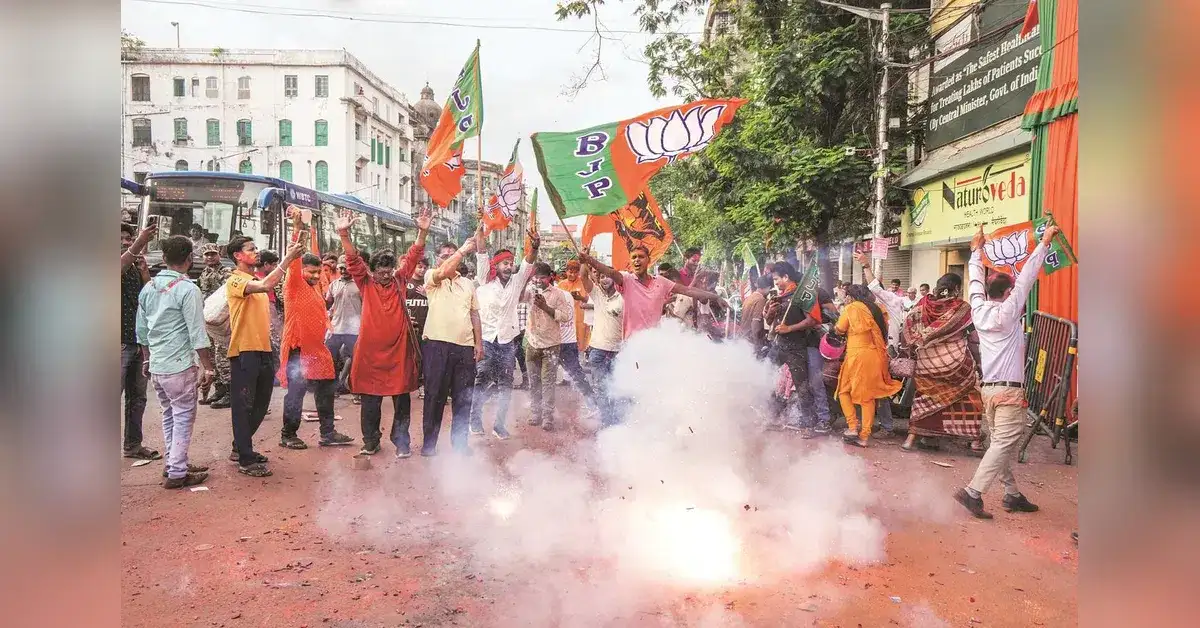
Historically, the BJP has never governed West Bengal. The election campaign was characterized by intense competition, with some reports questioning whether "fear" and a "show of power" influenced the electoral outcome. Celebrations erupted across the country following the announcement of the results.
The electoral map indicates a clear division, with the BJP leading in regions such as North Bengal and the Industrial Belt, while the TMC retained pockets of strength in minority-dominated constituencies and parts of Kolkata. The Congress and the Communist Party of India (Marxist) appear to have been largely marginalized, with early reports indicating zero leads for both parties in a contest that has effectively become bipolar between the BJP and the TMC. The intense electoral battle saw high-profile contests, including the closely watched seat between Mamata Banerjee and Suvendu Adhikari.
Read More: FBI Analysts Review Georgia 2020 Election Data in Fulton County
Background Dynamics
The election saw a reported surge in voter turnout, a phenomenon historically favoring organized, cadre-driven parties. The counting process itself, which commenced on May 4, 2026, with postal ballots followed by EVMs, faced delays and scrutiny. The Election Commission maintained that uniform security measures were in place and dismissed initial concerns about arrangements.
The narrative surrounding the BJP's victory has been linked to national political trends, with some suggesting the results indicate a country moving towards "nationalist forces." For its part, a BJP government in West Bengal has been anticipated by party leaders to expedite the processing of citizenship applications under the Citizenship Amendment Act.