Bitcoin has recently surged above the $72,000 mark, a climb that occurs within a broader landscape of considerable global market unease. This ascent appears linked to several converging factors, including persistent inflows into Bitcoin Exchange Traded Funds (ETFs) and a complex interplay of geopolitical tensions and macroeconomic pressures. The digital asset's price action, reaching peaks around $74,000 at times, has coincided with significant movements in traditional markets, with major US stock indices experiencing notable downturns.
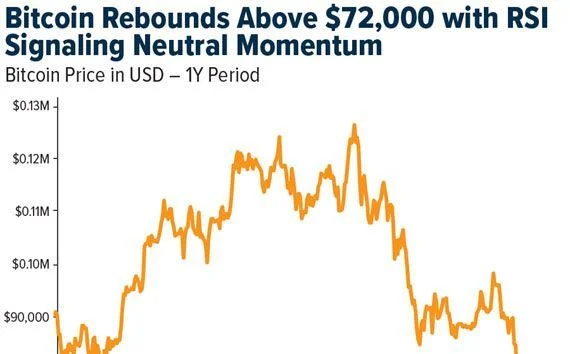
The significant inflows into Bitcoin ETFs, particularly in the US, are noted as a primary driver for tightening Bitcoin supply and bolstering market sentiment. Concurrently, geopolitical events, such as tensions involving Iran, have injected a layer of global uncertainty, paradoxically seeming to fuel demand for Bitcoin as a perceived safe haven or a hedge against traditional market instability. This has also led to the liquidation of significant short positions, with reports indicating hundreds of millions of dollars in leveraged bets being crushed during price rallies.
Read More: Solaris Energy SEI Stock Price Forecast Reaches $91.98 by July 2027
Further complicating the picture are observations of increased leverage within derivatives markets, a factor that analysts warn could amplify volatility. On-chain data presents a mixed narrative, with some indicators suggesting caution despite the upward price momentum. The Coinbase Premium, for instance, has been signaling institutional demand. Simultaneously, significant buy orders from larger cohorts of investors, particularly those allocating between $10,000 and $1 million, have been observed, adding hundreds of millions of dollars to Bitcoin's market.

Underlying Currents and Future Specter
While the recent price surge is a salient feature, the underlying mechanisms and potential future trajectories remain subjects of varied interpretation. The Bitcoin halving event, which concluded in April and reduced block mining rewards, is seen by some as a long-term bullish factor, potentially constraining supply further. Innovations within the Bitcoin ecosystem, such as the Nakamoto upgrade enhancing transaction throughput and Layer-2 (L2) solutions, are posited to reinvigorate interest in the broader Bitcoin network, separating the asset itself from its underlying technological infrastructure.
Read More: Binance Position Info V2 Changes API for Traders on April 7 2026

However, the specter of volatility looms large. The Bitcoin Volatility Index (BVIV) has reportedly surpassed trendline resistance, suggesting a period of increased price turbulence. Analysts point to shifts in market flows, weakened liquidity, and ongoing macro concerns as catalysts that could sustain this elevated level of volatility. Liquidity, the market's capacity to absorb large transactions without significant price swings, has diminished, potentially amplifying market movements.
The Shifting Sands of Market Perception
The narrative surrounding Bitcoin's price movements is not solely dictated by fundamental analysis or technical indicators. A significant element appears to be driven by market sentiment and a more intangible 'enthusiasm'. The very definition and the forces propelling Bitcoin's price remain elusive for some observers, leading to a proliferation of myths and confusion as renewed interest sweeps through the market. The belief in Bitcoin's future potential has, for some, taken on almost 'religious' dimensions, while others maintain that its scarcity, a core tenet of its value proposition, has long been factored into its price. The influx of more miners, attracted by rising prices, could also introduce new dynamics into the cost structures of the network.
Read More: Rocket Companies brand update in April 2026 changes logos and names
Historical Context and Structural Elements
The advent of Bitcoin ETFs has undeniably altered the investment landscape, offering avenues for traditional market participants to gain exposure to the cryptocurrency. This has directly benefited entities like crypto miners and firms holding substantial Bitcoin reserves, as the rising asset values translate into sharp gains. The limited supply of Bitcoin, set at 21 million coins, remains a foundational characteristic, though its influence on current price action is debated, with some arguing its impact is already priced in.
The current situation unfolds against a backdrop of broader market volatility. Major US stock market indices like the Dow Jones, S&P 500, and Nasdaq have experienced declines, drawing attention to the interconnectedness of digital assets and traditional financial instruments. The interplay between these markets, influenced by factors ranging from interest rate policies to global economic indicators, continues to shape investor behavior and asset valuations across the board.
Read More: Pearl Mining 2026: Technical Problems Cause Profit Loss