

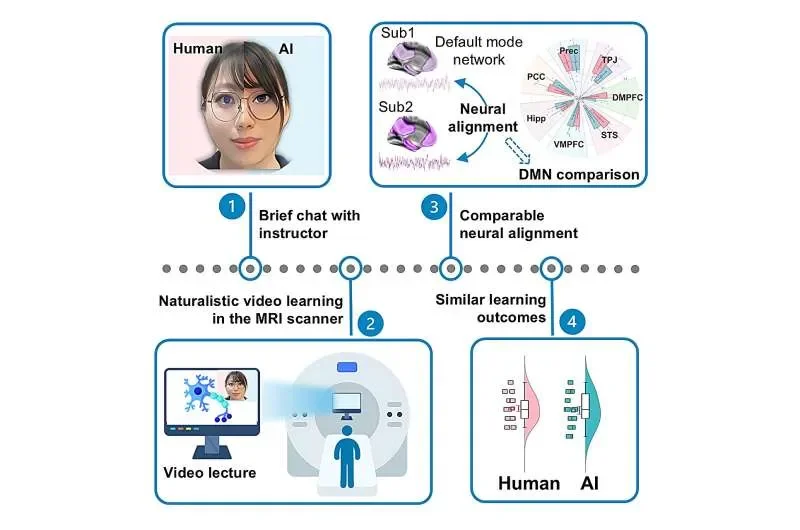
A recent study offers neuroscientific findings suggesting artificial intelligence can indeed stand alongside human educators. A brief, structured chat preceding a lecture appears to synchronize student brains, yielding learning results on par with those achieved by human instructors. This research marks a significant step in understanding AI's capacity to bolster online learning environments.
Students engaging in a short conversation, either with a human or an AI, exhibited heightened synchronized neural activity. These brain regions are critical for processing information, managing cognitive resources, and responding to social and emotional cues during subsequent learning. This neural alignment appears to be a key factor in the observed learning improvements.
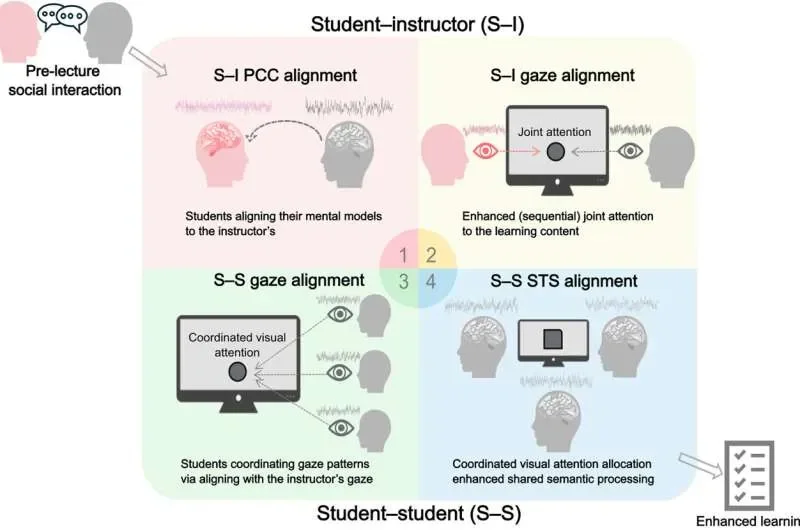
The investigation, detailed in the journal Neuron, involved two groups. One group interacted with a human instructor for 8–10 minutes before their learning session. The second group had a similar interaction with an AI instructor. Despite participants reporting feeling less socially connected to the AI and showing lower synchronized eye movements (gaze alignment) with the AI compared to the human, their learning outcomes were comparable. This points to the possibility that effective scaffolding for learning doesn't solely rely on interpersonal warmth or shared visual focus.
Read More: Students Choose Face-to-Face Meetings Over Phones
Neural Pathways to Learning
The study employed simultaneous eye-tracking and naturalistic fMRI to capture student engagement. This approach revealed that both AI and human instructors, through these preparatory conversations, could approximate the engagement levels that lead to improved neural alignment. ==The mediating role of neural and gaze alignment in learning improvements is a critical takeaway, suggesting that the mechanisms of learning can be influenced by structured pre-engagement.
Broader AI Engagement in Education
While this specific study focused on pre-lecture chats, other explorations into AI's role in education highlight a more expansive picture. Different forms of AI-driven feedback, such as metacognitive or affective prompts, are being investigated for their impact on learning and brain activity. One such study, published in npj Science of Learning in April 2025, examined how distinct chatbot feedback styles might influence student outcomes and neural engagement across 15 learning trials.
Read More: Nvidia Stock Rises After New Factory Plans with Corning
The Collaborative Frontier
The discourse around AI in education often centers on its potential to collaborate with human teachers, rather than replace them. Articles from May 2025 and January 2025 emphasize that AI excels with data and resource suggestions, while teachers provide crucial wisdom, spark curiosity, and offer mentoring. ==The proposed model is one of human-AI collaboration, where teachers can audit AI outputs and ensure diverse training data. This synergy aims to free educators to focus on more nuanced aspects of teaching, like conversational practice for immigrant students, while AI handles tasks like providing translated worksheets. The risk of students becoming overly dependent on AI for critical thinking is also a noted concern.
Read More: Trump brings back Presidential Physical Fitness Award for students
A Landscape of AI in Learning
Systematic literature reviews, including one from October 2023, have cataloged the varied applications of AI chatbots in educational settings, particularly within higher education. These reviews underscore the growing presence and potential of AI technologies in reshaping daily classroom operations and personalizing learning experiences.
Keywords: AI in education, neural alignment, learning outcomes, human-AI collaboration


