Recent developments in computational linguistics have converged on a singular technical requirement: verifying the accuracy of citations generated by large language models (LLMs). As these systems become integrated into research workflows, multiple open-source and peer-reviewed pipelines have emerged to address the persistent issue of "hallucinated" references.
Key Technical Frameworks and Signals
The industry is currently transitioning from manual verification to automated, pipeline-driven assessment. The primary objective is to decompose LLM-generated responses into atomic facts, verifying each against retrieved source material.
| Project/Tool | Primary Focus | Methodology |
|---|---|---|
| Citation Benchmark | Evaluation Pipeline | Uses ALCE framework; atomic fact decomposition; NLI-based validation. |
| CiteLab25 | Modular Toolkit | Web-based interface; standardized benchmarks for citation generation. |
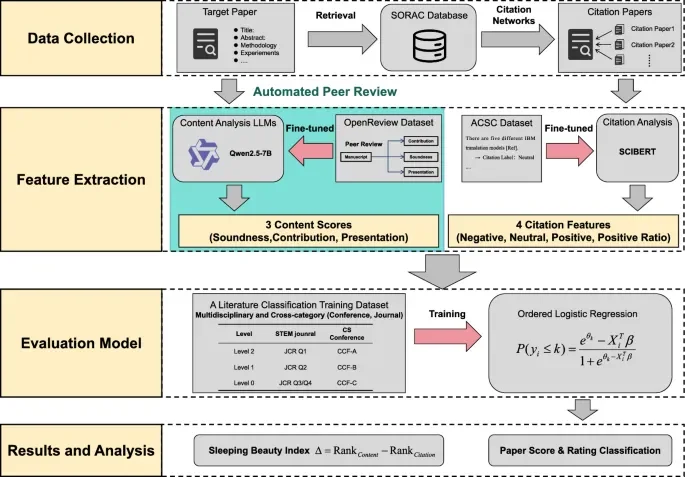
| Scientific Reports (Isik et al.) | Engineering Journals | Cross-quartile validation using automated LLM scoring. |
| Cicq | Unified Metrics | Integrates citation impact with textual content quality. |
Atomic Decomposition: Most contemporary pipelines, such as the
citation-benchmarkdeveloped at Sharif University of Technology, utilize a "referee" LLM (e.g., GPT-4o Mini) to isolate individual claims from generated text. These are then matched against external documents using vector retrieval or TF-IDF.Metric Standardisation: Researchers are moving toward a multi-factor scoring system that accounts for Citation Recall, Citation Precision, and standard linguistic markers like ROUGE-L and STR-EM.
Integration with Live Systems: These pipelines are designed to handle various citation formats, specifically targeting the superscript-based markers found in systems like Microsoft Copilot and the bracketed indices typical of Perplexity.AI.
Implementation and Constraints
Deployment of these systems requires significant local infrastructure. Effective validation of long-form responses typically necessitates CUDA-compatible hardware (minimum 16GB VRAM) and access to gated models via Hugging Face.
The MainPipeline.ipynb workflows allow users to conduct end-to-end inference, utilizing ICL (In-context learning) demonstrations to stabilize model performance.
The research published in Scientific Reports (April 6, 2026) highlights a specific focus on "engineering journal quartiles," suggesting an attempt to apply these automated tools to academic prestige metrics and quality control.
Background and Context
The drive to automate citation verification stems from the inherent inability of autoregressive language models to distinguish between verified data and plausible-sounding fabrication. While early attempts at "RAG" (Retrieval-Augmented Generation) improved the source material provided to models, they did not solve the secondary problem of ensuring the model correctly links its output to those specific sources.
Read More: Chrome mimeHandler API lets extensions handle file types
These recent efforts, particularly those codified in open-source repositories like CiteLab25 and the Citation Benchmark, reflect a broader attempt to move LLMs from generalist text generators to verifiable academic tools. The reliance on NLI (Natural Language Inference) models for automated fact-checking represents the current technical consensus on how to reduce the margin of error in machine-generated bibliographic output.