


The Indian higher education market is undergoing a jagged pivot as the state prepares to let in dozens of outsiders. Dharmendra Pradhan, the Union Education Minister, confirmed to the Rajya Sabha that while three foreign universities are already running on soil, more than 50 others have approached the University Grants Commission (UGC) for entry. This influx follows a warning from Dr. M.C. Sudhakar, Karnataka’s Higher Education Minister, who stated that public universities must "compete" or face "setbacks" against these private and international entities.
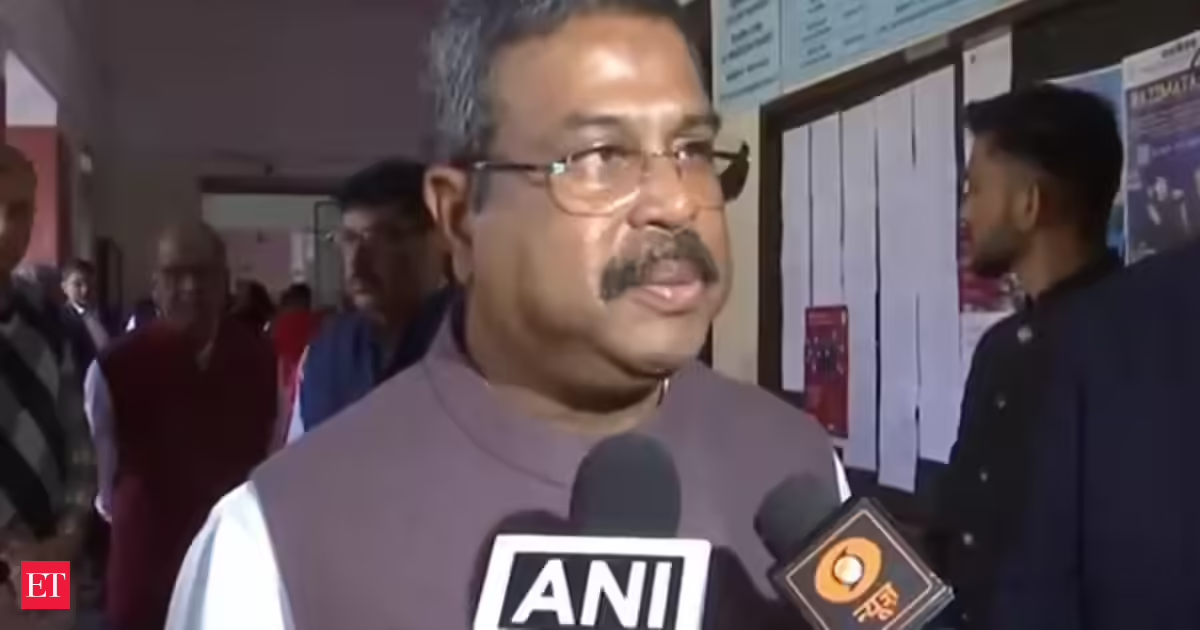
"If government universities fail to maintain higher academic standards, they will face setbacks from private and foreign universities," Sudhakar noted during a Memorandum of Understanding signing between the Karnataka State Higher Education Council and the British Council.
The state is effectively acknowledging a structural rot in its own institutions, inviting external competition to act as a corrective pressure for a system plagued by thin research and aging syllabi.

The Scale of the Encroachment
The rush of applications signals a shift from the old habit of students leaving to a new reality of brands arriving. The UGC regulations now allow these Foreign Higher Educational Institutions (FHEI) to operate through joint ventures or solo campuses.

| Metric | Status / Fact |
|---|---|
| Active Foreign Varsities | 3 currently operating in India |
| Pending Applications | 50+ in talks with UGC and state governments |
| Regulatory Perk | Full autonomy in fixing fee structures |
| Employment Focus | Direct links to Multinational Companies (MNCs) and Australian firms |
Placement Traps: New campuses claim they will offer on-campus placements with MNCs that previously ignored the Indian college circuit.
The Rural Gap: Dr. Sudhakar argues these International Collaborations are meant to give rural students "exposure," though the price of such exposure remains tethered to foreign fee models.
Accreditation: Foreign schools will keep their home-country standards, creating a two-tier system of Credentialing within the same borders.
The Autonomy Disconnect
There is a visible friction between the freedom granted to outsiders and the leash kept on locals. While the UGC allows foreign entities to decide their own fees and admission rules, domestic public universities remain bound by state-mandated pricing and rigid hiring protocols. Debdulal Thakur, a Professor at Vinayaka Mission’s School of Economics, suggests that while these campuses might slow the "outbound mobility" of students, they won't stop it entirely because the domestic Research Culture remains thin.

Experiential Learning: Foreign brands market "doing" over "memorizing," a lure for a middle class tired of the rote-heavy Indian Syllabus.
Investment Yoking: Unlike previous attempts to open the sector, the current wave ties foreign investment directly to "national priorities," a phrase often masking the need for private capital to fix public failures.
Background: The Push for "Global" Soil
The backdrop of this expansion is the National Education Policy (NEP), which seeks to internationalize a system that has historically been closed to protect local "quality" (or perhaps local mediocrity). For years, the Brain Drain has been a statistical embarrassment for the state; bringing the campuses to India is an attempt to capture that capital—both human and financial—before it boards a flight.
The UGC's liberalized rules are described by some as "enabling," but they highlight a lopsided reality: the state is asking its own ragged schools to fight a "battle of excellence" against wealthy global giants while keeping the local schools' hands tied by old bureaucracy.