

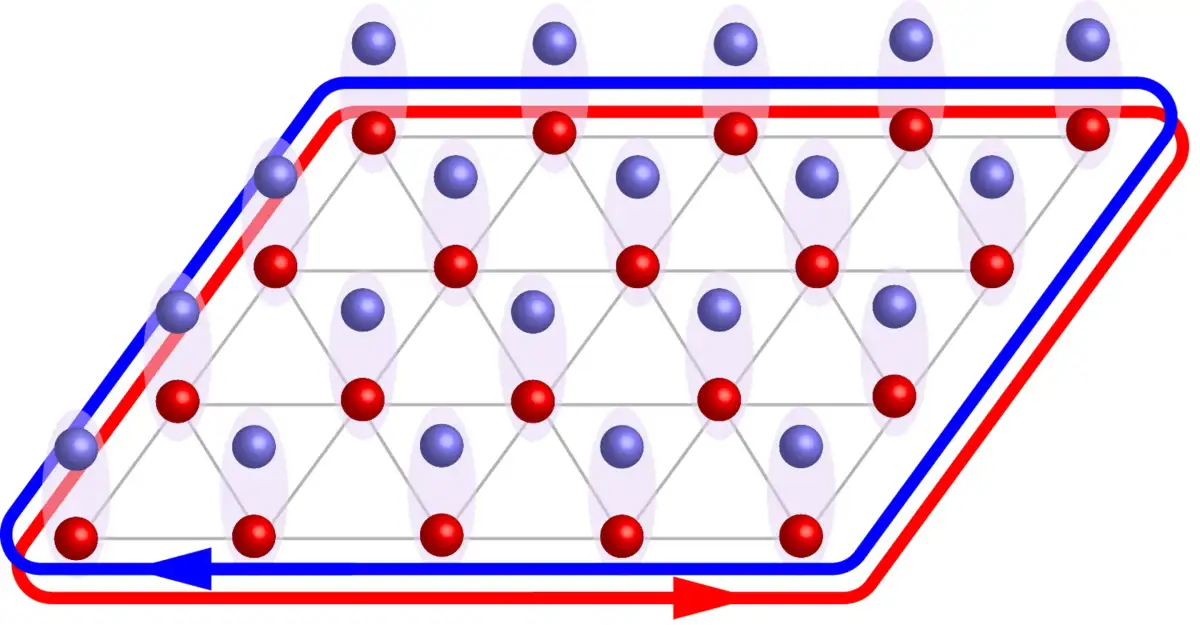
Physicists have shifted the search for the topological Kondo insulator from messy three-dimensional chunks to a flat, controlled sandwich of Transition-Metal-Dichalcogenides. By twisting layers of MoTe2 and WSe2 into a moiré pattern, researchers produced a state where electrons mimic a heavy liquid that refuses to flow through the center but clings to the edges.
This marks the first confirmed sighting of this state in a two-dimensional system, a configuration that allows for tuning that bulk crystals like SmB6 never permitted.
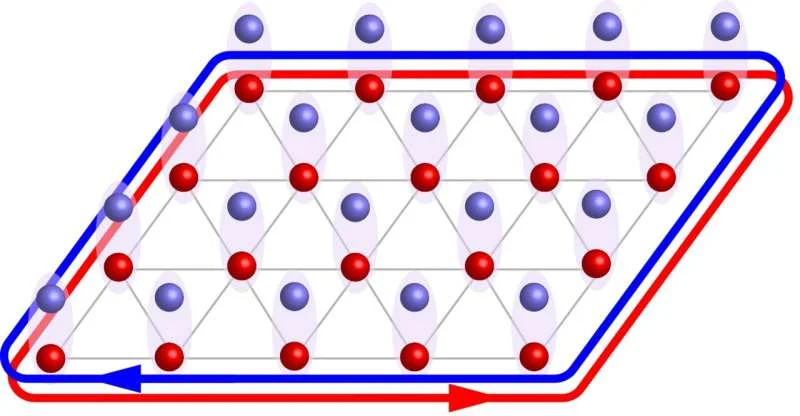
"In a semiconductor bilayer system, local moments in one layer interact with itinerant carriers in the other to realize a two-dimensional topological Kondo insulator."
The Mechanics of the Overlap
The architecture of this experiment relies on the Moiré-Superlattice, a jagged interference pattern created by stacking two atomic sheets with a slight misalignment. This grid forces a standoff between two types of electron behavior:
Local Moments: Stationary electrons trapped in the MoTe2 layer acting as magnetic anchors.
Itinerant Carriers: Mobile electrons in the WSe2 layer attempting to move through the lattice.
Hybridization: The forced marriage of these two types creates "heavy fermions," particles with immense effective mass that eventually choke out conduction in the interior.
The result is a vacuum of movement within the material’s guts, while a thin, protected current survives at the boundary. This topology is not a fluke of the material's chemistry but a product of the geometric Kondo-Twist applied by the researchers.

Dimensional Discrepancy
| Feature | 3D Bulk (Traditional) | 2D Moiré (New) |
|---|---|---|
| Material | Samarium Hexaboride (SmB6) | MoTe2/WSe2 Bilayer |
| Control | Fixed by crystal growth | Tunable by voltage and twist angle |
| Observation | Hard to distinguish bulk/surface | Clearer isolation of edge states |
| Signal | Noisy, often debated | High signal due to layer separation |
The Industry of the Small
The transition from 3D to 2D is less about "better" physics and more about the desire for Structural-Utility. Bulk materials are stubborn; they are what they are. In the moiré bilayer, the Kondo effect—once a curiosity of cold metals—becomes a knob that can be turned.
The significance lies in the forced interaction between layers. By separating the electrons that provide the "magnetic" backdrop from the electrons that carry the "current," the experimenters have dismantled the Kondo insulator into its component parts and rebuilt it on a flat plane.
Background on the Kondo Lag
Historically, the Kondo effect explained why some metals stop getting more conductive as they get colder—magnetic impurities scatter the electrons. In a Kondo insulator, this scattering becomes so pervasive that the material stops conducting entirely, except where the "topology" of the electron's path forces a loophole. While predicted for decades, proving this happened in 2D remained an elusive goal until this recent manipulation of dichalcogenide stacks. The "twist" in the moiré lattice provides the necessary Spatial-Periodicity to simulate the environment of a heavy-fermion crystal without the baggage of a three-dimensional volume.