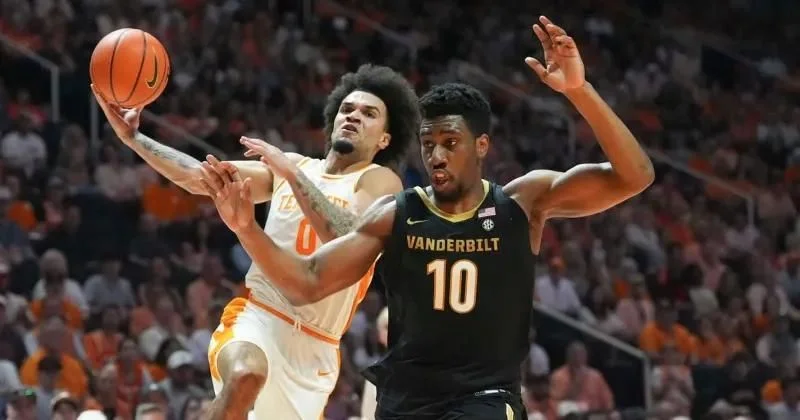
The victory over Vanderbilt has solidified Tennessee as a No. 5 seed in the shifting geometry of tournament projections. As of late February, analysts including Joe Lunardi position the team in the West Region, though the opening geography remains cluttered, with potential games in Philadelphia against No. 12 South Florida.
The win in Nashville corrected a downward slide that previously saw the team dip to a No. 7 seed in late January.
Current NET ranking metrics place the team at No. 14, a number that disagrees slightly with KenPom (No. 19) but aligns with BartTorvik (No. 14).
The team’s durability is tied to its defense, which ranks No. 14 nationally, whereas the offense lingers at No. 28.
A critical 5-6 record in Quad 1 contests serves as the primary weight on their seeding ceiling, contrasted by a sterile 7-0 record in Quad 4.
The Math of the Resume
The bracket remains a guess based on fragile data. Tennessee’s current position is a product of high-level defensive efficiency and a schedule that has finally yielded to a string of SEC wins.
| Metric Provider | Rank | Offensive Rank | Defensive Rank |
|---|---|---|---|
| EvanMiya | 15 | 28 | 14 |
| KenPom | 14-19* | N/A | N/A |
| BartTorvik | 14 | 30 | 16 |
| NET | 14 | N/A | N/A |
*Fluctuation noted across reporting dates.
Potential Matchups and Brackets
In the current logic, the path through the tournament is narrow and filled with familiar names.
If the No. 5 seed holds, Tennessee likely faces a dangerous No. 12 seed, with names like South Florida or Yale surfacing in recent drafts.
Secondary matchups involve a collision with No. 4 Michigan State or a potential upset survivor like No. 13 High Point or Stephen F. Austin.
Other SEC entities clutter the field; Florida currently holds the highest conference seed at No. 3, while Alabama and Arkansas hover near the Vols in the No. 4 and No. 5 slots.
"The Vols not only dropped from a No. 6 to a No. 7 in the new projection, but they’re also the final team on the No. 7-seed line as Lunardi’s No. 28 overall seed." (Source: Jan 24 Update)
The core signal: Tennessee’s volatility has settled into a No. 5 seed expectation, dependent on a top-tier defense to mask an offense that fluctuates outside the top 25.
Contextual History and Trajectory
The current season is the 11th for Rick Barnes at the helm of Tennessee Basketball. The program is experiencing its most consistent era of relevance, though the seeding numbers often suggest a team that dominates the regular season only to face statistical traps in the early rounds.
Read More: FIFA World Cup 2026 Revenue Reaches $15 Billion With New Ticket Prices
Earlier in February, the outlook was bleaker. Following a loss to Kentucky, the team was relegated to a No. 6 or No. 7 seed. The recent recovery—marked by wins over LSU, Oklahoma, and Vanderbilt—has restored their status as a "Top 20" team. The remaining schedule offers further volatility, with No. 18 Alabama and No. 21 Vanderbilt (rematch) serving as final opportunities to manipulate the NCAA Tournament committee’s spreadsheets before the SEC Tournament begins on March 11 in Nashville.
Reflective Observation: The obsession with "Quad" wins and decimal-point rankings reveals a sport increasingly governed by algorithmic ghosts. Tennessee exists as a sturdy, defensive entity in this system—unlikely to fall out of the field, but currently lacking the offensive efficiency to climb into the elite "No. 1 or No. 2" conversations. The seeding is less a reflection of "talent" and more a ledger of survived encounters.
Read More: Tennessee 2026 All-State Tennis Teams Announced for High Schools