


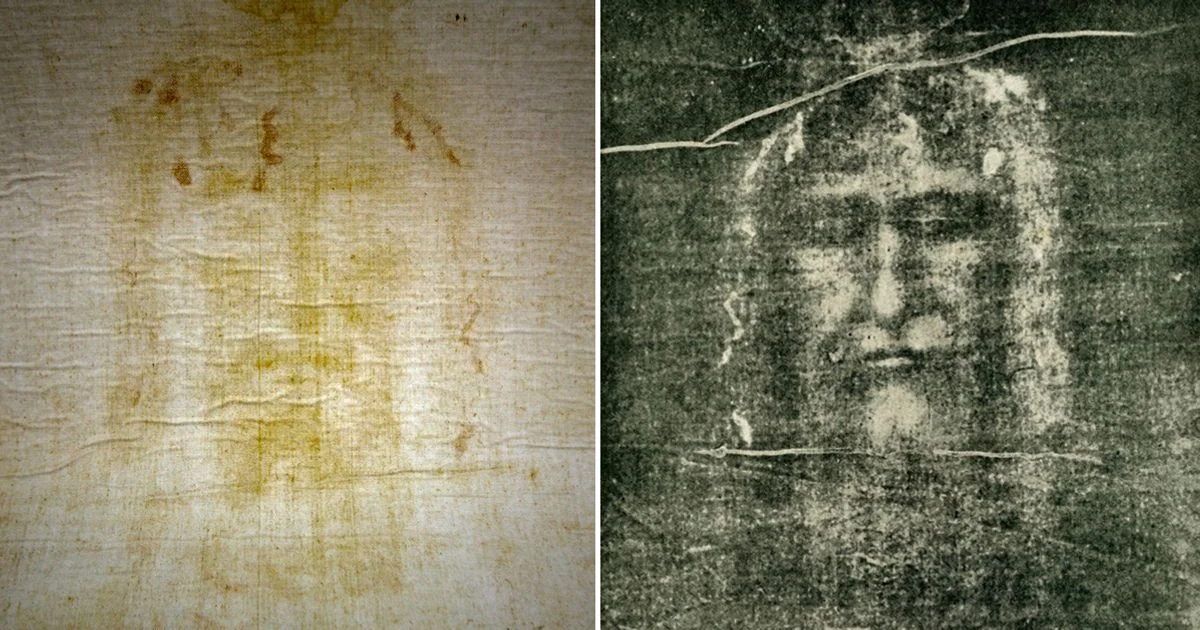
The Shroud of Turin, a linen cloth bearing the faint image of a man's body, remains one of history's most profound and debated relics. For centuries, it has been venerated by some as the actual burial cloth of Jesus Christ, imprinted with his image after the crucifixion. Others maintain it is a medieval fabrication. Recent scientific investigations and historical discoveries have introduced new evidence, intensifying this long-standing argument and presenting a complex tapestry of claims regarding its origins.
The Shroud of Turin, a linen cloth bearing the faint image of a man's body, has been a focal point of intense scholarly and religious debate for generations. Its significance stems from the belief held by many that it is the burial shroud of Jesus Christ, bearing his likeness imprinted after his death. This belief, however, is countered by scientific analyses and historical findings that suggest a later origin, pointing towards a potential medieval forgery. The ongoing examination of this artifact, marked by a crucified man with injuries consistent with biblical accounts, continues to present conflicting interpretations of its authenticity.
Evidence and Counter-Evidence
The Shroud of Turin is a linen cloth featuring the image of a crucified man, displaying marks that proponents suggest align with biblical descriptions of Jesus' suffering.
Evidence for Authenticity:
Forensic testing indicates the blood stains on the Shroud are human, type AB, and contain high levels of bilirubin, associated with severe trauma like scourging and crucifixion.
New dating methods, such as WAXS, which examines the crystalline structure of linen over time, have placed the cloth in the first century.
Scientists claim the image is not composed of paint, dye, or any known pigment.
The depiction of the man being nailed through the wrists, rather than the palms, is a detail not commonly known until recent image-enhancement technology.
Historical evidence is cited to place the cloth in Christian veneration long before the Middle Ages.
Evidence Against Authenticity:
A newly unearthed medieval document, detailed in a recent study, is presented as the oldest evidence suggesting the Shroud is a "clerical fraud."
Previous radiocarbon dating in 1988 placed the Shroud's origins in the late 13th or 14th century.
A 3D analysis published in the journal Archaeometry concluded the cloth had been wrapped around a sculpture, not a human body.
The existence of the Shroud in the Middle Ages is not disputed, but the question remains whether it is a genuine relic or a skillfully crafted fake from that period.
Scientific Scrutiny
Scientific investigations have yielded data that is interpreted differently by various researchers, leading to persistent questions about the Shroud's age and image formation.
Dating the Cloth
Initial radiocarbon dating conducted in 1988 by three different laboratories concluded that the Shroud originated between 1260 and 1390 AD. This dating is a significant point of contention for those who believe in its authenticity.
Proponents of authenticity argue that the 1988 carbon dating was based on a sample that was not representative of the entire Shroud, possibly due to repairs or contamination.
Newer methods, like WAXS, are presented as more reliable for determining the age of linen based on its molecular structure. These studies suggest the Shroud belongs to the first century.
Conversely, the findings from the 1988 dating remain a substantial basis for arguments against its authenticity, positing a medieval origin for the artifact.
Image Formation and Materials
The precise method by which the image on the Shroud was created is another area of extensive scientific inquiry.
Researchers claim that forensic analysis confirms the presence of real human blood, type AB, on the cloth, along with elevated bilirubin levels. This is interpreted as evidence of severe trauma consistent with crucifixion.
A key argument for authenticity is the assertion that the image is not a product of paint, dye, or any known pigment, suggesting an inexplicable formation process.
However, the conclusion that the cloth was wrapped around a sculpture, rather than a body, implies a deliberate artistic creation rather than a natural imprint.
The detailed anatomical features, such as nail wounds through the wrists, are presented as evidence that aligns with precise knowledge of crucifixion, possibly known only in antiquity or through advanced modern analysis.
Historical Narratives
The historical trajectory of the Shroud is also subject to competing interpretations, with new documents adding layers to the existing debate.
Medieval Origins vs. Ancient Relic
The appearance of the Shroud in documented historical records in the mid-14th century is undisputed.
Read More: Turin Shroud Authenticity Debated: New Evidence Suggests Medieval Artistry or First-Century Origin

A newly discovered medieval document is presented as evidence of "clerical fraud," suggesting the Shroud was known to be a fake during that period. This document is described as offering the oldest and most compelling evidence of its fraudulent nature.
Conversely, some researchers propose a continuity of historical evidence that places the Shroud in Christian veneration before the Middle Ages, suggesting it was not an invention of that era.
The narrative of the Shroud appearing "from nowhere in the Middle Ages" is contested by those who believe in its ancient origins and a long, albeit sometimes obscured, history.
Expert Perspectives
Scholarly opinions on the Shroud of Turin remain divided, reflecting the complex nature of the evidence.
"The evidence for the Shroud of Turin’s authenticity has never been stronger: The 1988 carbon dating has been discredited due to a non-original sample. New X-ray dating places the cloth in the first century. No paints or pigments were used to create the image. The blood is real, from a traumatized, crucified corpse. The spear wound confirms post-mortem trauma. Historical evidence places the cloth in Christian veneration long before the Middle Ages." - From Article 4
"A unearthed document, detailed in a new study, offers compelling and the oldest evidence that the Turin Shroud - long believed to be the burial cloth of Jesus Christ - is 'clerical fraud.' This case gives us an unusually detailed account of clerical fraud.” - From Article 2
"While science may never prove beyond doubt that the Shroud wrapped the body of Jesus Christ, it is now far more reasonable to accept the Shroud as a genuine first-century artifact—and possibly the greatest physical link to the Resurrection ever discovered." - From Article 4
Conclusion
The discourse surrounding the Shroud of Turin is characterized by a persistent tension between scientific findings and historical interpretations, with recent evidence reinforcing both sides of the argument.
Evidence presented for the Shroud's authenticity includes forensic analysis of blood, advanced dating techniques suggesting a first-century origin, and the unexplained nature of the image formation. These findings are supported by historical arguments that place the relic in veneration prior to the Middle Ages.
Conversely, the established 1988 radiocarbon dating remains a significant challenge to claims of authenticity. The discovery of a medieval document further bolsters the perspective that the Shroud may be a historical forgery, specifically a "clerical fraud."
The presence of blood, trauma markers, and the specific details of the crucifixion image continue to be scrutinized, offering grounds for both belief and skepticism.
The debate over the Shroud of Turin's authenticity is not definitively settled. The continuing investigation involves the reconciliation of radiocarbon dating, new dating methodologies, forensic evidence, and the interpretation of historical documents. Each piece of new information adds complexity to an already intricate puzzle, ensuring that the Shroud will remain a subject of rigorous examination and profound discussion.
Sources
Irish Times: New evidence for the authenticity of the Shroud of Turin (Dec 19, 2024) - https://www.irishtimes.com/science/2024/12/19/new-evidence-for-the-authenticity-of-the-shroud-of-turin/
Euronews: Newly discovered document adds evidence that Shroud of Turin is fake (Aug 29, 2025) - https://www.euronews.com/culture/2025/08/29/newly-discovered-document-adds-evidence-that-shroud-of-turin-is-not-jesus-crucifixion-shro
The Mirror: New Turin Shroud evidence uncovers 'truth' as to whether Jesus was under it (Mar 1, 2025) - https://www.mirror.co.uk/news/world-news/new-overwhelming-turin-shroud-evidence-34777079
Substack (John Daniels): The Shroud of Turin: New Scientific Evidence Builds the Strongest Case Yet for Authenticity (Jul 31, 2025) - https://johndaniels.substack.com/p/the-shroud-of-turin-new-scientific
The Archaeologist: New Findings Reinforce the Authenticity Debate of the Turin Shroud (Aug 22, 2024) - https://www.thearchaeologist.org/blog/new-findings-reinforce-the-authenticity-debate-of-the-turin-shroud
Newsweek: Discovery reveals we've been debunking the Shroud of Turin for 650 years (Aug 29, 2025) - https://www.newsweek.com/archaeology-bible-jesus-shroud-turin-650-years-debunk-2121470



)