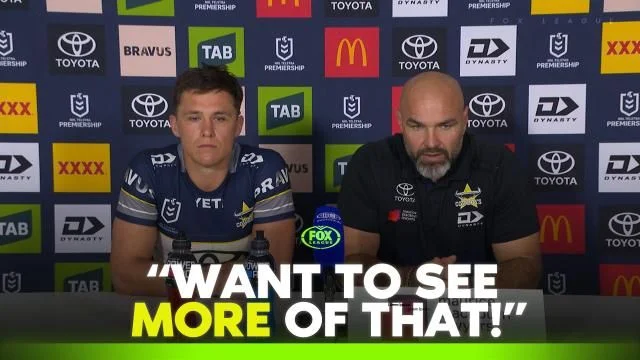
The National Rugby League (NRL) faces persistent questions regarding its 'disruptor' rule, with recent admissions of incorrect decisions highlighting a wider confusion among officials and stakeholders. This has led to high-profile figures, including former player Billy Slater, voicing significant criticism. The ambiguity surrounding what constitutes legitimate contest versus illegal interference under the high ball has become a focal point, particularly after a contentious call in a recent match between the Storm and the Roosters.
Confusion Surrounds Kick-Pressure Interpretations
The controversy has repeatedly resurfaced, notably during the Storm's win over the Roosters in round seven. Melbourne great Billy Slater has been vocal, stating his dismay with the interpretations of the 'disruptor' rule, calling some of the recent judgments "stupid." He elaborated that the league is struggling to differentiate between players genuinely attempting to contest the ball and those engaging in obstruction or interference. Recent events underscore this point, with the NRL itself admitting to having "got them wrong" in several contentious 'disruptor' incidents. This admission came after a try was controversially disallowed for the Roosters' Rob Toia, with the governing body clarifying that a one-handed approach to aerial contests is not inherently illegal.
Read More: Giro d'Italia 2026 Broadcasts: Where to Watch in Different Countries
The ongoing debate centers on the application of penalties for actions during kick returns. Slater has previously pointed out that players are being penalized for actions that were previously considered a fundamental part of the game, such as applying kick pressure. The rule, designed to ensure fair contest for the ball, appears to be creating unintended consequences, leading to confusion about what constitutes legitimate play versus foul. This has even prompted comparisons to other sports, with the expansion of team benches to six players recently being described by Slater as making the game "a little bit more NFL-like," suggesting a shift in strategic complexity that may stem from a desire to manage player fatigue or tactical options.
Read More: Mitchell Moses Out of State of Origin Game 1
Broader Rule Adjustments Under Scrutiny
Beyond the 'disruptor' rule, other recent rule changes have also drawn commentary. The expansion of the player bench from four to six players, while intended to offer coaches more tactical flexibility, has also been met with observation. Slater acknowledged that while such changes have pros and cons, the increased bench size introduces a more specialized, almost NFL-style approach to team composition. However, he noted that the actual interchange cap remains at eight, limiting the extent to which this expanded bench can be utilized dynamically within a single game.
Background: The Evolving Game
The 'disruptor' rule, and the broader adjustments to officiating and player rules, are part of an ongoing effort by the NRL to manage the flow and integrity of the game. Historically, rules have been refined to address player safety, enhance spectacle, and ensure fairness. However, the recent spate of controversies surrounding the 'disruptor' rule suggests a period of recalibration, where the intended outcomes of rule changes are being challenged by their real-world application on the field. The admission of errors by the NRL signals a willingness to address these issues, but the persistent questions point to a complex challenge in achieving clarity and consistency in officiating.
Read More: Detroit Tigers' Kenley Jansen Out With Pelvic Pain