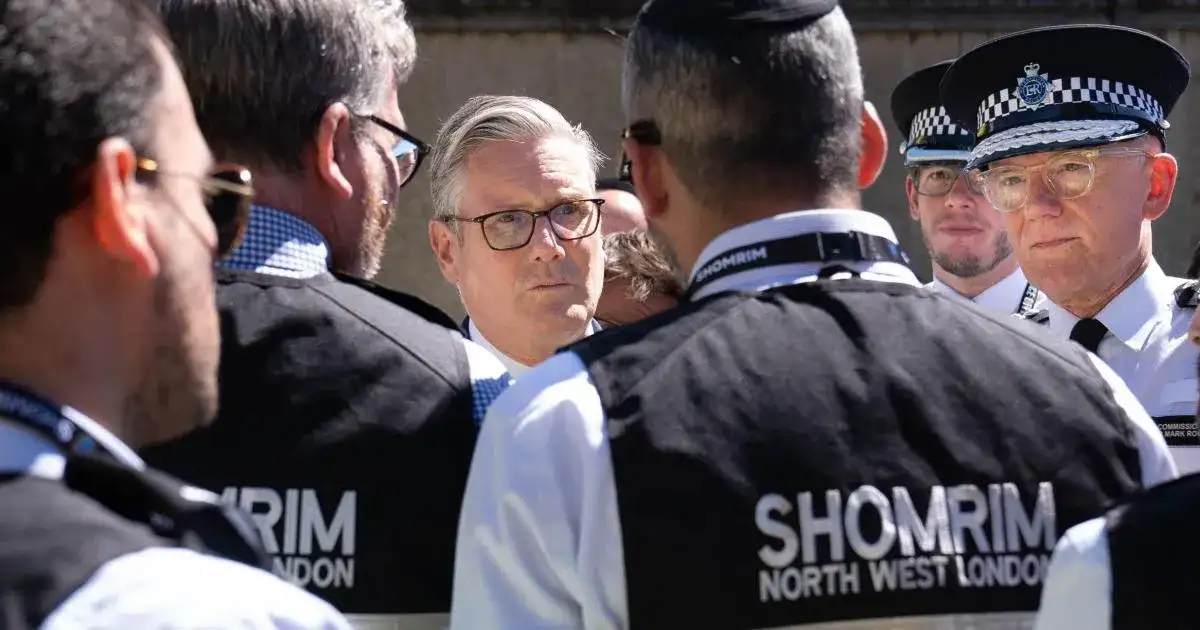
Prime Minister Keir Starmer convened leaders from across public life at Downing Street today to confront what he termed a "crisis for all of us" – the escalating attacks against Britain's Jewish community. The meeting, described as a call for a "whole of society response," follows a spate of incidents, including the recent stabbing of two Jewish men in Golders Green, which the Metropolitan Police has classified as a terrorist incident.
The government's response is framed as a crucial step in confronting extremism and protecting Jewish communities, directly linking the domestic security situation to international events, specifically the Iran war and its "domestic security implications."
This gathering seeks to accelerate existing efforts to combat antisemitism, building on recent government commitments. Ministers are expected to chair sector-specific meetings, addressing concerns ranging from extremism and hate speech to the protection of vulnerable communities.
Read More: Labour Wins Stafford Seat After 14 Years of Conservative Rule
Golders Green Incident and Broader Threat
The summit is a direct response to a series of concerning events. The stabbing of two Jewish men, identified as Shloime Rand, 34, and Norman Shine, 76, in Golders Green on April 29th has been central to the urgency. Essa Suleiman, 45, has been charged with attempted murder and possessing a knife in connection with this attack. This incident follows earlier events, such as the arson of ambulances belonging to the Jewish charity Hatzola in March, and the recent vandalism of a memorial wall in Golders Green, for which two arrests were made. The Metropolitan Police's declaration of the Golders Green stabbing as a terrorist incident has heightened concerns, with the UK's overall terror threat level having been raised to 'severe'.
Calls for Stricter Measures
The Prime Minister's initiative occurs against a backdrop of calls for more decisive action. Conservative leader Kemi Badenoch has publicly advocated for a ban on certain pro-Palestine marches, citing their perceived impact on the Jewish community. This sentiment reflects a broader unease regarding the normalization of antisemitism, as articulated by the Chief Rabbi, who recently told the BBC that such hatred is "not taken seriously enough."
Read More: Health Secretary Reviews Antidepressants for Children in Washington D.C.
Context of International Conflict
The heightened focus on antisemitism is also intertwined with the government's assessment of geopolitical tensions. The ministerial meeting of the Middle East Response Committee, a crisis team established to address the conflict, is set to discuss the domestic security ramifications of the Iran war, including an acknowledged increased threat to Jewish communities. This suggests a governmental perspective that views domestic security and international relations as inextricably linked in the current climate.