


The Stakes are High for Next-Generation Laptops
New computer processors, known as Intel Panther Lake, are poised to change how laptops perform. These chips promise faster speeds and better graphics, aiming to make laptops more capable for demanding tasks like gaming and creative work. Reports suggest these new processors could offer significant improvements over previous generations, raising questions about how they will stack up against competitors and what this means for the future of mobile computing. The key lies in balancing increased power with efficient energy use, a common challenge in laptop design.
New Chips, New Capabilities
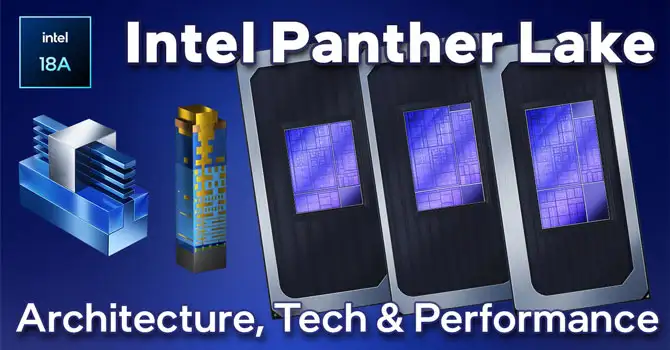
Intel has unveiled its Panther Lake processor family, also referred to as the Core Ultra Series 3, intended for laptops and potentially entry-level desktops. This new line of processors aims to build upon Intel's recent advancements, leveraging a hybrid core design.

Hybrid Architecture: Panther Lake chips utilize a mix of performance cores (p-cores) for heavy tasks, efficiency cores (e-cores) for everyday operations, and low-power efficiency cores (LP E-cores) to minimize energy consumption. This approach is designed to strike a balance between speed and battery life.
Manufacturing Process: A significant aspect of Panther Lake is its production using Intel's 18A manufacturing process. This is described as Intel's most advanced chip-making process currently in production in the United States, which is expected to contribute to performance and efficiency gains.
Graphics Advancement: The processors feature integrated graphics based on the Xe3 (Celestial) architecture. The higher-end configurations include up to 12 Xe3 cores, promising substantial improvements in graphics performance, including ray tracing capabilities and AI-driven enhancements.
Product Tiers: Intel has outlined various configurations within the Panther Lake family, including series like Core Ultra 300V, 300H, and 300HX, suggesting a range of performance levels to suit different market segments. Specific SKUs like the Core Ultra X7 358H and Core Ultra X9 388H have been mentioned.
Connectivity: Support for Wi-Fi 7 and Bluetooth 6.0 are integrated, alongside multiple Thunderbolt 4 ports and potential support for Thunderbolt 5.
Evidence of Performance and Efficiency
Multiple reports and reviews have begun to detail the capabilities of Intel's Panther Lake processors, with a focus on performance benchmarks and efficiency claims.
Performance Metrics:
Tests on an MSI Prestige 14 laptop with a Core Ultra X7 358H chip showed good performance, both when plugged in and on battery power.
Some reports suggest Panther Lake offers up to 50% faster performance compared to its predecessor, Lunar Lake, particularly in integrated graphics.
Intel claims Panther Lake provides over 50% better multi-threaded performance than both Lunar Lake and Meteor Lake.
Single-threaded performance is projected to be 10% higher than Lunar Lake at the same power level.
Gaming performance is highlighted, with claims of up to 76% faster gaming performance and some X-series chips reportedly matching the performance of a discrete RTX 4050.
Graphics Benchmarks:
The integrated graphics on Panther Lake have shown impressive results in benchmarks. A 3DMark Time Spy Graphics score of 6,300 has been noted for an energy-efficient chip.
In a standard benchmark comparing Panther Lake to a Strix Point mini-PC, Panther Lake delivered 29.05fps versus 15.66fps, an 85.5% improvement.
Intel promises up to a 77% performance lead over Lunar Lake and an 82 percentage point advantage over AMD's Strix Point-based Ryzen AI 9 HX 370 with its Radeon 890M graphics.
Efficiency Claims:
Intel positions Panther Lake as advancing power efficiency while increasing compute throughput.
The new Darkmont cores are said to surpass previous core designs in performance while using less power.
The hybrid core design, utilizing e-cores for less intensive tasks, is intended to minimize power draw and enhance battery life.
Integrated Graphics: A Leap Forward?
The integrated graphics unit (iGPU) within the Panther Lake processors has been a significant focus, with Intel aiming to reduce the need for discrete graphics cards in many laptops.
Xe3 Architecture: Powered by the Xe3 (Celestial) architecture, the iGPU is designed to offer substantial graphical power. The flagship Panther Lake configurations feature 12 Xe-cores and include ray tracing units.
Performance Comparisons: While impressive, the iGPU's performance in synthetic benchmarks has been noted. In 3DMark Time Spy, the 6,300 score is strong for integrated graphics, but falls short of some discrete offerings and competitor integrated solutions like AMD's Radeon 8060S, which scored around 11,000 points.
Real-World Impact: Despite benchmark comparisons, reports suggest the ARC B390i GPU, a key component of Panther Lake, aims to make high-settings gaming a reality on thin notebooks. This indicates a practical improvement for everyday users and gamers.
Competitor Analysis: Intel's Panther Lake is compared to AMD's Strix Point and Strix Halo processors. While Panther Lake shows significant gains over Strix Point, comparisons with AMD's top-tier integrated graphics suggest a competitive landscape where specific workloads and configurations will determine the ultimate victor.
Core Design: P-cores, E-cores, and LP E-cores
Panther Lake's architecture revisits a three-tier core design, similar to Intel's earlier Meteor Lake processors, with an emphasis on optimizing performance across different usage scenarios.
Hybrid Approach: The processors feature a combination of performance cores (P-cores) for demanding computations, efficiency cores (E-cores) for general multitasking, and low-power efficiency cores (LP E-cores) to conserve energy during idle or light tasks.
Evolution of Cores: The Darkmont efficiency cores are highlighted as a key improvement. Intel claims these new E-cores now surpass even Raptor Cove performance levels while operating within tighter power constraints.
Core Configuration: Specific configurations mentioned include designs with 4 P-cores, 4 LP E-cores or 4 P-cores, 8 E-cores, and 4 LP E-cores. The top-end Core Ultra X9 388H features 16 cores, described as 4 P-cores, 8 E-cores, and 4 LP E-cores.
Performance Differentiation: The strategic use of these different core types is intended to dynamically allocate resources, ensuring maximum performance when needed for intensive tasks like gaming and creative applications, while conserving power during everyday use like web browsing or document editing.
Manufacturing and Efficiency: The 18A Advantage
The production process is seen as a crucial factor in Panther Lake's claimed performance and efficiency improvements.
Intel 18A Process: Panther Lake processors are built using Intel's 18A manufacturing process. This is presented as a significant technological advancement, enabling higher transistor density and improved power management.
Efficiency Gains: Intel asserts that the advancements in the 18A process are a major contributor to the performance and efficiency uplift claimed over previous architectures like Arrow Lake and Lunar Lake.
Power Consumption: Reports indicate significantly reduced power consumption for similar workloads, leading to better overall efficiency. This is critical for extending battery life in laptops.
Manufacturing Location: The 18A process being in production in the United States positions Intel to potentially increase domestic chip manufacturing capabilities.
Conclusion: A Promising Contender
Intel's Panther Lake processors appear to represent a notable step forward in mobile computing. The combination of a refined hybrid core architecture, advancements in integrated graphics, and the utilization of the cutting-edge 18A manufacturing process suggests a strong offering in the laptop market.
Performance Metrics: The reported gains in both CPU and GPU performance, including significant increases in multi-threaded tasks and gaming capabilities, indicate that Panther Lake is designed to handle demanding applications effectively.
Efficiency Focus: The emphasis on improved power efficiency alongside performance is crucial for the mobile segment, potentially leading to longer battery life without compromising user experience.
Competitive Landscape: While early benchmarks show promise and Intel is making bold claims, especially against its own previous generations and some competitors like AMD's Ryzen series, a comprehensive real-world evaluation will be necessary to fully assess its market standing.
Next Steps: Further testing across a wider range of applications and under various real-world conditions will be important to validate these initial findings and understand the full impact of Panther Lake on the laptop market. The integration into diverse laptop models will also dictate its ultimate success.
Sources
MobileSyrup: Intel Panther Lake performance: return of the king?🔗 https://mobilesyrup.com/2026/02/27/intel-panther-lake-core-ultra-x7-performance-review/
TomsGuide: I just tested Intel’s Panther Lake chip — 50% faster, breakthrough graphics and ready to power laptops in 2026🔗 https://www.tomsguide.com/computing/cpus/intel-panther-lake-cpus-promise-insane-gains-50-percent-faster-with-a-breakthrough-gpu
TechPowerUp: Intel Panther Lake Technical Deep Dive🔗 https://www.techpowerup.com/review/intel-panther-lake-technical-deep-dive/11.html
Notebookcheck: Early Intel Panther Lake iGPU benchmark impresses with 50% faster performance vs Lunar Lake🔗 https://www.notebookcheck.net/Early-Intel-Panther-Lake-iGPU-benchmark-impresses-with-50-faster-performance-vs-Lunar-Lake.1138923.0.html
DigitalFoundry: Intel Panther Lake: Mobile Graphics, Entry-Level Desktop Performance🔗 https://www.digitalfoundry.net/news/2026/01/10/intel-panther-lake-mobile-graphics-entry-level-desktop-performance
Geeky-Gadgets: Intel Panther Lake performance🔗 https://www.geeky-gadgets.com/intel-panther-lake-performance/
Tom's Hardware: Intel doubles down on gaming with Panther Lake, claims 76% faster gaming performance — new X-series chips can match discrete RTX 4050🔗 https://www.tomshardware.com/pc-components/cpus/intel-doubles-down-on-gaming-with-panther-lake-claims-76-percent-faster-gaming-performance-new-x-series-chips-deliver-up-to-12-xe3-cores
HotHardware: Intel Panther Lake Performance Unveiled: Core Ultra Series 3 Roars To Life At CES🔗 https://hothardware.com/news/intel-ces-2026-panther-lake-is-a-go
PCWorld: Panther Lake unveiled: A deep dive into Intel's next-gen laptop CPU🔗 https://www.pcworld.com/article/2928765/panther-lake-unveiled-a-deep-dive-into-intels-next-gen-laptop-cpu.html