While the Government of India reports the deployment of 1,094 drones across 22 states under the Namo Drone Didi scheme, records indicate zero expenditure despite the formal release of operational guidelines. The gap between the hardware arrival and financial accounting suggests a fragmented implementation structure where administrative throughput lags behind physical procurement.
| Deployment Metric | Current Status |
|---|---|
| Total Drones Distributed | 1,094 units |
| Allocation for ‘Namo Drone Didi’ | 500 units |
| Total Scheme Outlay (2023–2026) | ₹1,261 Crores |
| Target Beneficiaries | 15,000 Women SHGs |
Operational Mechanics and Financial Friction
The Namo Drone Didi Scheme operates as a Central Sector Scheme aimed at transitioning rural labor into drone service providers. State-level committees hold the authority to select clusters and Self Help Groups (SHGs) under the Deendayal Antyodaya Yojana – National Rural Livelihoods Mission (DAY-NRLM).
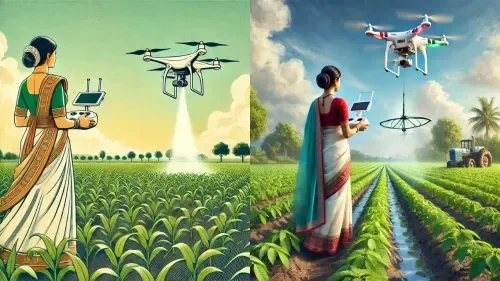
Subsidized Acquisition: Eligible SHGs are promised subsidies for drone purchase to offset operational costs.
Economic Integration: The goal remains the adoption of Nano-fertilizers and precision pesticide application to shift agrarian input efficiencies.
Administrative Delays: Despite the high-level policy framework, localized reporting—notably in Karnataka—shows varied uptake levels, while some documentation indicates the application process remains stalled or incomplete in multiple regions as of late 2025.
Investigating the Administrative Void
The discrepancy between the 1,094 drones in circulation and the reported zero expenditure points to an accounting asymmetry. It is unclear whether these drones were provided through state-central partnerships that bypass direct budgetary reporting or if the equipment remains tied up in pending procurement audits.
Read More: PMKVY Training Scheme Questioned Over Job Skills Mismatch
The scheme's objective relies heavily on the assumption that grassroots institutions can manage the maintenance and technical requirements of drone flight. With an ambitious target of 15,000 groups, the success of this initiative hinges not on the hardware delivery itself, but on the capacity of rural federations to transform a centralized handout into a sustainable livelihood model.
Context: The 'Drone Didi' Framework
The scheme emerged from the broader Lakhpati Didi mission, framing technological disruption as a tool for financial inclusion. By targeting women-led collectives, the government aims to centralize control over agricultural output while simultaneously addressing rural unemployment. The long-term efficacy remains tethered to whether these drone service providers can achieve economic viability once the initial subsidy support is exhausted or if the program risks becoming a static inventory of underutilized machinery.