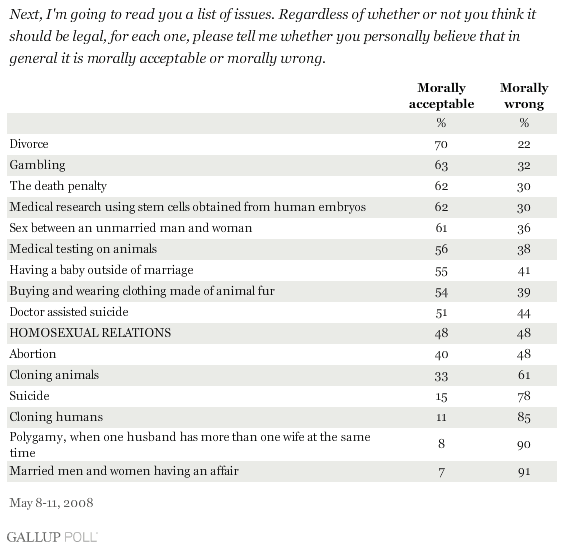
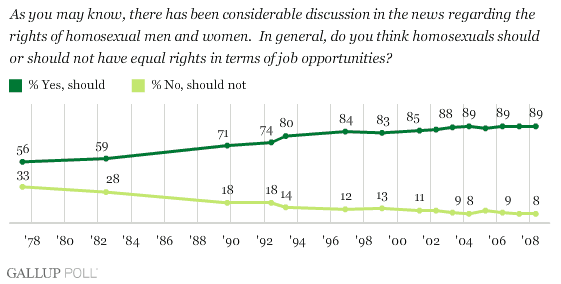
Public perception regarding the morality of same-sex relations remains highly sensitive to how inquiries are constructed. Data tracked from 2001 through 2026 demonstrates that =reporting on social values is not a neutral reflection of reality, but a product of specific linguistic choices=. Longitudinal data indicates that shifts in public stance often correlate with the exact phrasing of survey instruments rather than monolithic societal transformations.
| Survey Element | Impact on Result |
|---|---|
| Phrasing | "Acceptable" vs. "Legal" alters participant response significantly. |
| Political Alignment | Recent cycles show increased variance between ideological groups. |
| Context | Definitions of "lifestyle" versus "relations" influence public posture. |
The Influence of Syntax
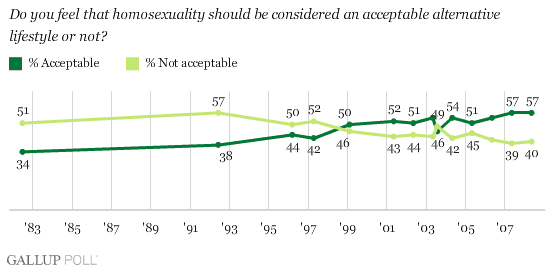
Academic inquiries, such as the 2018 experiment in the International Journal of Public Opinion Research, emphasize that =question-wording functions as a variable rather than a constant=. When pollsters utilize terms like "acceptable alternative lifestyle"—as seen in early 2000s Gallup surveys—the responses differ from those prompted by queries regarding the "moral acceptability of relations."
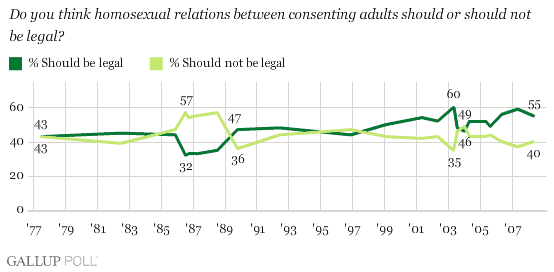
Linguistic Variance: Older polls frequently tested for the "acceptability of a lifestyle," a term that inherently biases the respondent toward a personal judgment of behavior rather than a stance on civil status.
Ideological Polarization: Recent data from 2025 suggests a growing divergence between political parties, with Republicans reporting more conservative views on these matters compared to previous decades.
Measured Reversal: While the broader trajectory of the 21st century appeared to trend toward liberal tolerance, recent measurements identify a measurable contraction in reported acceptability for same-sex relations.
Persistent Discrepancies
The record of public sentiment is rarely linear. While various outlets characterize shifts as a "gradual cultural movement," the data indicates periods of oscillation. As of early 2026, the interpretation of this information depends heavily on the timeframes selected for comparison.
Read More: WNBA Players Face Online Harassment Increases in April 2026
The reliance on standardized polling has historically faced critique regarding whether the subjects understand the questions in a uniform way. Whether an individual defines "morality" as a religious construct, a social convention, or a legal standard remains unverified within the typical polling framework. This ambiguity means that what is reported as a "change in values" may frequently represent a "change in semantic interpretation."
Background on Data Collection
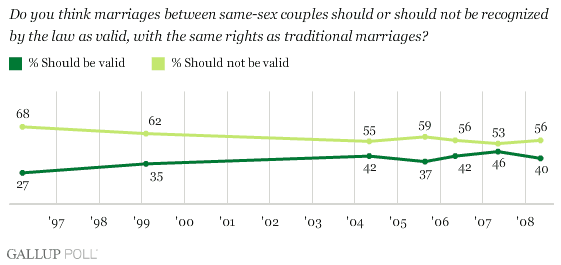
The study of these trends relies primarily on long-term tracking polls which maintain consistent questions over decades to isolate change. However, as the language used to discuss these subjects in daily life evolves, the gap between the rigid phrasing of a poll and the contemporary vernacular expands. The resulting numbers offer a record of response patterns rather than an immutable truth of societal consensus.