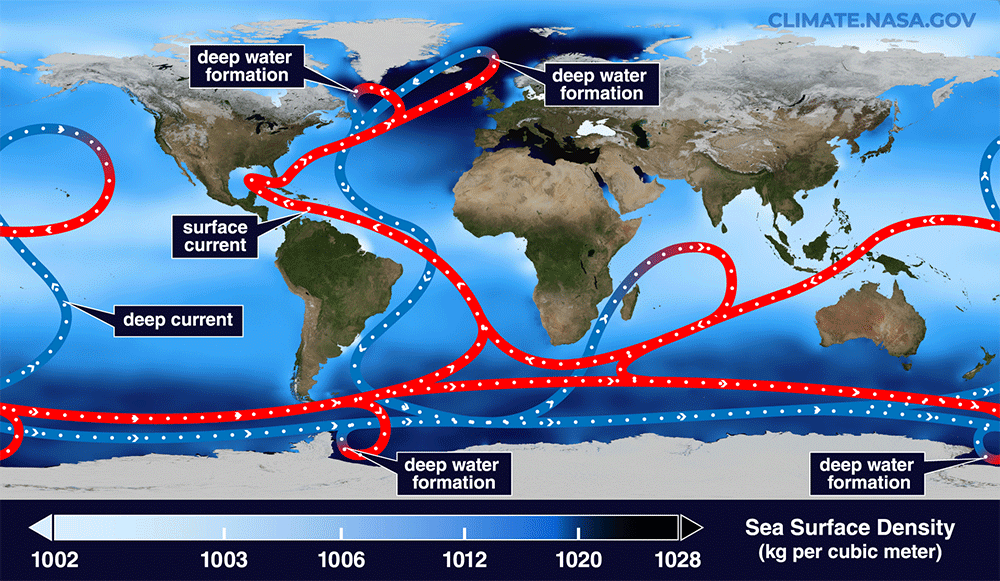
The Atlantic ocean’s heat-distribution engine, the Atlantic Meridional Overturning Circulation (AMOC), is displaying structural instability evidenced by a persistent northward migration of the Gulf Stream. Recent data from Feb 2026 indicates the current is drifting at 71.5°W, a geographical deviation that functions as a precursor to total hydraulic failure. This shift occurs as the Deep Western Boundary Current, a cold undercurrent that typically anchors the Gulf Stream to the south, loses its momentum and fails to exert its usual pull.

Modeling suggests that an abrupt northward lurch is not merely a seasonal fluke but a signal of a coming halt.
The collapse sequence follows a specific chronology: initial destabilization is followed approximately 25 years later by the total cessation of the AMOC.
This stagnation results from a failure in "deep convection" within the Labrador Sea, where surface water no longer reaches the density required to sink and drive the southward return flow.
Mechanics of Fluid Failure
The system functions on a salt feedback mechanism. Under normal conditions, the Atlantic imports salty surface water and exports fresher deep water. However, an influx of freshwater from melting ice and milder winters creates a "freshening" effect. This less-dense water refuses to sink, effectively choking the "conveyor belt."

"When conditions suppress deep convection, whether through surface freshening, milder winters, or both, less dense water forms, less water sinks, and the overturning weakens."
| Variable | Normal State | Destabilized State |
|---|---|---|
| Gulf Stream Path | Southerly/Stable | Northward Shift at 71.5°W |
| Deep Boundary Current | Robust/Cold | Weakened/Retreating |
| Labrador Sea Density | High (Sinking) | Low (Buoyant/Stagnant) |
| Continental Shelf | Stable Levels | Rising/Warming |
Divergent Timelines and Data Friction
While some statistical models point toward a tipping point as early as 2025, the scientific community remains fractured over the validity of these projections. Critics argue that these timelines rely on rigid assumptions about a climate system that is inherently asymmetrical and irregular.
Read More: French Marine Survey to Chart Barrels and Effects on Sea Life

Many researchers claim the 2025 Prediction is based on insufficient historical evidence and fails to account for the extreme complexity of ocean-atmosphere feedback loops.
Conversely, newer observational data from altimetry and the "north wall" of the Gulf Stream suggest the destabilization is already observable, regardless of the specific year the final "tipping" occurs.
Geographic Fallout
If the system disintegrates, the redistribution of global heat will be heavy-handed and uneven. The lack of northward warm-water transport would lead to a "deep freeze" in European winters, while simultaneously increasing storm activity.
Europe: Likely to face extreme winter cooling, though this may be partially mitigated if global atmospheric temperatures rise by 4 degrees Celsius, creating a bizarre thermal tug-of-war.
North American Coast: As the current slows, water that was once pulled away from the coast piles up, accelerating sea-level rise on the US Eastern Seaboard.
Global Tropics: Potential shifts in rainfall patterns as the thermal balance of the hemispheres is disrupted.
Background: The Conveyor’s Role
The AMOC is the primary regulator of the Atlantic’s metabolic state. It acts as a massive heat exchanger, pulling warmth from the Gulf of Mexico toward the North Atlantic. The Deep Western Boundary Current acts as the return pipe, carrying cold, dense water along the ocean floor. The current anxiety stems from the realization that this "river within the ocean" is not a permanent fixture, but a fragile equilibrium dependent on specific ratios of salt, ice, and wind.
Read More: Climate Advocate Rafe Pomerance Dies at 79