Recent analysis indicates that the European Union provides significantly more financial support to meat and dairy production compared to plant-based protein sources like legumes, nuts, and seeds. This disparity exists despite calls from scientists to shift towards more sustainable and healthier food options. The findings suggest a potential misalignment between current agricultural funding and public health and environmental goals.
The Flow of EU Agricultural Funds
The European Union's Common Agricultural Policy (CAP) directs substantial funds to its agricultural sector. These subsidies are distributed through various mechanisms, including direct payments to farmers and support for rural development, climate action, and natural resource management.
CAP Funding Streams: Support is channeled via the European Agricultural Guarantee Fund and the European Agricultural Fund for Rural Development.
Beneficiaries: Agriculture is a key industry across all EU member states, with farmers being the primary recipients of these funds.
Policy Alignment: The allocation of CAP funds is tied to the EU's long-term budgetary plans.
Disproportionate Support for Livestock
A new study by Foodrise, with research contributions from Leiden University, highlights a significant imbalance in subsidy allocation. The analysis suggests that livestock farming, particularly beef and dairy, receives a vastly larger share of EU subsidies when compared to plant-based protein alternatives.
Read More: New Wheat Makes Bigger Starch for Food and Industry

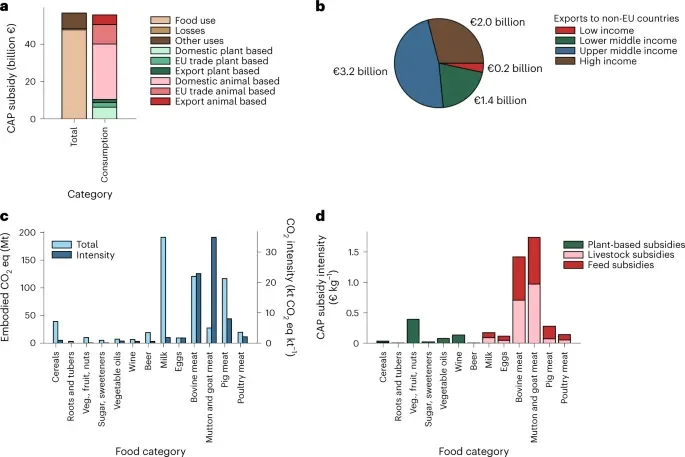
Beef and Lamb vs. Legumes: Beef and lamb production receive approximately 580 times more in EU subsidies than legumes.
Dairy vs. Nuts and Seeds: Dairy farming benefits from 554 times more in subsidies than nuts and seeds.
Overall Meat and Dairy: Collectively, meat and dairy production receive over 10 times more subsidy funding than the combined production of fruits and vegetables.
Comparison with Cereals: Meat and dairy production also receive 16 times more funding than cereal production.
The study indicates that EU subsidies are heavily skewed towards animal-based products, a pattern that has persisted for some time and is detailed in recent analyses.
The Role of Subsidies in Production and Consumption
These subsidies play a crucial role in supporting European livestock producers, who are described as being highly reliant on this financial assistance for their income. The financial support for animal agriculture, including that for animal feed, accounts for a significant portion of the EU's agricultural subsidies.
Direct and Indirect Support: 82 percent of EU agricultural subsidies are reported to support animal-based foods, with 38 percent directly and 44 percent allocated for animal feed.
Price Influence: Subsidization practices are seen as making animal-based diets "artificially cheap," influencing both production and consumption patterns.
Feed Concentrate Dependence: Some subsidies are directed towards pastureland maintenance to reduce reliance on feed concentrates and mitigate greenhouse gas emissions.
This extensive subsidization suggests that the economic viability of current levels of livestock production may be significantly influenced by EU financial policies.

Environmental and Health Considerations
Critics argue that the current subsidy structure runs counter to EU health and climate objectives. The production of animal-based foods is linked to substantial environmental impacts, including greenhouse gas emissions, biodiversity loss, and water pollution.
Emissions Intensity: Animal-based products are responsible for the vast majority ( 84 percent ) of greenhouse gas emissions originating from EU food production.
Broader Environmental Impact: These products are identified as major drivers of the EU's food-related greenhouse gas emissions, biodiversity loss, water consumption, and air and water pollution.
Policy Recommendations: Experts suggest that reforms are necessary to build a more sustainable and resilient food system, better aligned with public health outcomes.
"The shameful use of EU funds to promote meat and dairy to EU citizens – which is directly contrary to EU health and climate goals – should end immediately."
The current subsidy system is presented as potentially working against stated EU goals related to public health and climate action.
Read More: BEREC Asks for Mobile Network API Ideas from Developers
Recommendations for Policy Reform
Organizations like Foodrise are calling for a shift in EU agricultural policy, advocating for increased support for plant-based food production and promotion.
End Meat and Dairy Promotion: A call has been made to cease the use of EU funds for promoting meat and dairy products.
Increase Plant-Based Funding: Proposals include increasing CAP funding available for the promotion of plant-based whole foods.
Strategic Dialogue Recommendations: Key recommendations from the Strategic Dialogue report include implementing a Plant-Based Action Plan and an Agri-food Just Transition Fund to support farmers in transitioning towards more sustainable practices.
"It’s scandalous that such an unfair share of EU subsidies, worth billions of euros of EU taxpayers’ money, are being pumped into propping up high-emissions meat and dairy production and distorting European diets."
The core of the reform proposals centers on redirecting financial support to encourage a transition towards plant-rich diets and sustainable farming methods.
Expert Analysis
Researchers and campaigners highlight that the current CAP's subsidy allocation has significant implications for the broader food system, impacting diets, trade, and climate change efforts.
Anniek Kortleve, a researcher at Leiden University and lead author of the study, noted that reforms need to consider the entire subsidy chain, from feed to livestock, not just direct payments to farms.
Martin Bowman, a campaigner at Foodrise, stated that the analysis reveals disproportionate support for livestock even before accounting for societal costs like pollution. He added that the current system distorts European diets and should be urgently re-evaluated.
Read More: Karnataka requests higher Totapuri mango limit for farmers in April 2026
Conclusion and Future Implications
The findings from the Foodrise study and related analyses present a compelling case for a re-evaluation of the European Union's Common Agricultural Policy. The evidence suggests a substantial financial advantage for meat and dairy producers over plant-based alternatives, which has potential implications for environmental sustainability, public health, and the achievement of climate targets.
Subsidy Imbalance: The data consistently shows a multi-hundred-fold difference in subsidies favouring animal products over plant-based proteins.
Alignment with Goals: Questions are raised about how the current subsidy structure aligns with the EU's stated commitments to health and climate action.
Call for Transition: There is a clear call from research and advocacy groups for policy reforms that support a transition to more sustainable diets and farming practices.
The evidence points towards a need for policy intervention to address this subsidy disparity and foster a more balanced and sustainable agricultural sector within the EU. The extent to which these findings will influence future CAP reforms remains a subject of ongoing observation.
Sources Used
The Guardian: Published 59 minutes ago. https://www.theguardian.com/environment/2026/feb/19/beef-lamb-legumes-eu-subsidies-study
vegconomist: Published 4 hours ago. https://vegconomist.com/agriculture-agribusiness/foodrise-reveals-eu-spends-hundreds-of-times-more-subsidies-on-high-emissions-beef-and-dairy-than-legumes-and-nuts/
Foodrise Press Release: Published 6 hours ago. https://foodrise.org.uk/press-release-cap-crossroads/
Green Queen: Published 5 hours ago. https://www.greenqueen.com.hk/eu-meat-subsidies-cap-beef-dairy-plant-based-food-lobby/
The Conversation: Published Apr 3, 2024. https://theconversation.com/over-80-of-the-eus-farming-subsidies-support-emissions-intensive-animal-products-new-study
Nature Food: Published Apr 1, 2024. https://www.nature.com/articles/s43016-024-00949-4
Plant Based News: Published Apr 4, 2024. https://plantbasednews.org/news/environment/subsidies-eu-supports-animal-agriculture/
ScienceDirect: Published Apr 5, 2024. https://www.sciencedirect.com/science/article/pii/S0959652624005213