Bulgaria's Dara secured the nation's inaugural Eurovision Song Contest win, amassing 516 points. The win marks a significant moment for the country, which returned to the competition after a three-year hiatus. This year's contest, held in Vienna, Austria, at the Wiener Stadthalle, also saw Israel's Noam Bettan finish in second place with 343 points, followed by Romania's Alexandra Căpitănescu with 296 points.
The European Broadcasting Union (EBU) maintained its position on Israel's participation, citing its membership rules and emphasizing the contest's non-political nature. This stance, however, has been met with considerable criticism due to the ongoing conflict in Gaza, a point of contention that persisted throughout the event.
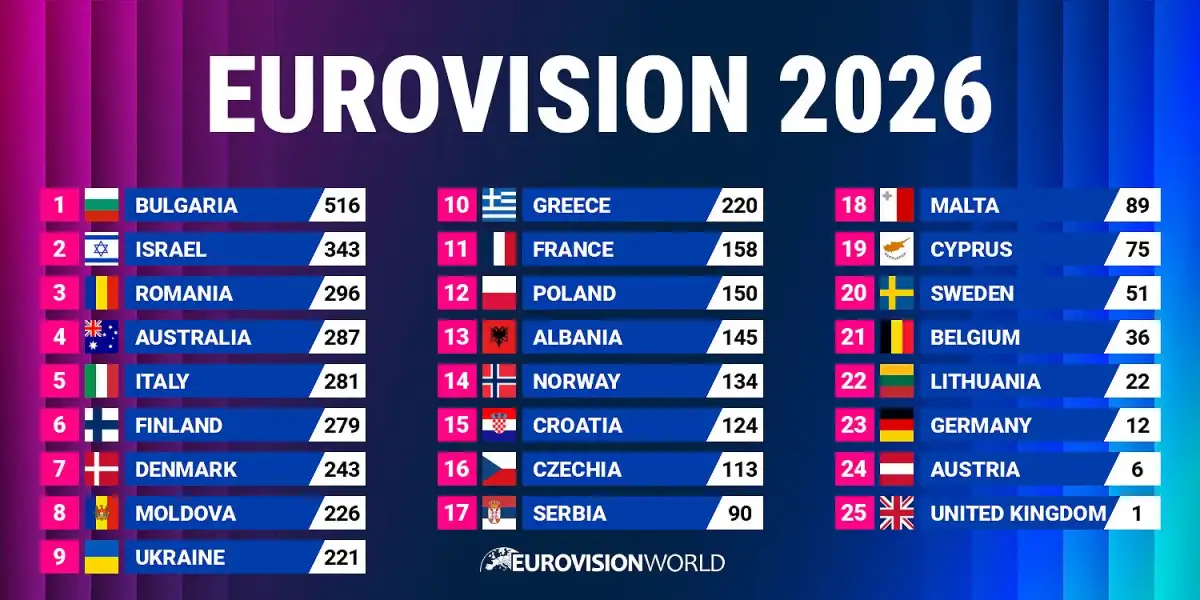
The 70th Eurovision Song Contest featured 35 participating countries, with 25 acts progressing to the Grand Final. Voting was a combination of national juries and public televotes, alongside an online "Rest of the world" vote. Notable rule changes for 2026 included a reduction in the number of capped televotes per payment method from 20 to 10, and an increase in national jury members from five to seven.
Read More: Taylor Swift and Travis Kelce Marry at Madison Square Garden
The broadcast was hosted by Victoria Swarovski, Michael Ostrowski, and Emily Busvine in the Green Room. The event, organized by the Austrian national broadcaster ORF, was the third time Vienna has hosted the competition, having previously done so in 1967 and 2015. A significant allocation of up to €22.6 million was provided to the city for the organization of the contest.
Points Breakdown:
| Country | Artist | Points |
|---|---|---|
| Bulgaria | Dara | 516 |
| Israel | Noam Bettan | 343 |
| Romania | Alexandra Căpitănescu | 296 |
| Australia | Delta Goodrem | 287 |
| Italy | Sal Da Vinci | 281 |
| Finland | Linda Lampenius x Pete Parkkonen | 279 |
| Denmark | Søren Torpegaard Lund | 243 |
| Moldova | Satoshi | 226 |
| Ukraine | LELÉKA | 221 |
| Greece | Akylas | 220 |
| France | Monroe | 158 |
| Poland | ALICJA | 150 |
| Albania | Alis | 145 |
| Norway | JONAS LOVV | 134 |
| Croatia | LELEK | 124 |
| Czechia | Daniel Žižka | 113 |
| Serbia | LAVINA | 90 |
| Malta | AIDAN | 89 |
| Cyprus | Antigoni | 75 |
| Sweden | FELICIA | 51 |
| Belgium | ESSYLA | 36 |
| Lithuania | Lion Ceccah | 22 |
| Germany | Sarah Engels | 12 |
| Austria | COSMÓ | 6 |
| United Kingdom | Look Mum No Computer | 1 |
Background and Context
The Eurovision Song Contest, a flagship event of the EBU, operates under rules dictating that participating nations must have an active EBU membership and a national broadcaster capable of receiving and airing the contest. This year's event was no exception to the long-standing traditions of the competition, which has consistently showcased a diverse range of musical styles and cultural expressions from across Europe and beyond. The contest, often described as "Europe's favourite TV show," continues to be a significant platform for emerging artists and a reflection of the continent's cultural landscape, even as it navigates contemporary geopolitical sensitivities.
Read More: Europe June 2026 heatwave caused 39 percent rise in Belgium deaths



:max_bytes(150000):strip_icc():focal(799x0:801x2)/nyc-sky-taylor-swift-travis-kelce-wedding-070326-2dc0d912004b400eac2c8c8b5adeff2a.jpg)