Recent events surrounding a White House TikTok video featuring U.S. Olympic hockey player Brady Tkachuk have sparked debate about the authenticity of digital media and its potential to spread misinformation. The video, which includes fabricated audio of Tkachuk making disparaging remarks about Canadians, has been publicly denounced by the athlete as "clearly fake." This incident occurred in the wake of the U.S. men's Olympic hockey team's victory over Canada, a win that led to a celebratory call with President Donald Trump.
The controversy centers on a video posted on the White House's official TikTok account. This video contained synthesized audio that purported to be Tkachuk using offensive language towards Canadians, including a reference to them as "maple syrup eating f—-s" (with the expletive bleeped). Crucially, the video itself was marked as containing "AI-generated media." Tkachuk has emphatically stated that the voice in the video is not his and that the lip movements do not match. He has also asserted that he would never use such language.
Read More: Backyard Baseball 2026: New Game Coming to PC and Consoles in July
Further complicating the narrative, Tkachuk also denied being the voice heard on a separate video of the team's celebratory call with President Trump, where a voice reportedly shouted "close the northern border." This call took place after the U.S. men's team defeated Canada 2-1 in overtime to win the gold medal. The U.S. women's team had also recently secured a gold medal by defeating Canada.
Tkachuk's Rejection of the Video's Content
Brady Tkachuk has firmly rejected the authenticity of the White House TikTok video and its alleged audio content.
Tkachuk described the video as "clearly fake," pointing out discrepancies in the voice and lip synchronization.
He explicitly stated, "I would never say anything like that."
The hockey player emphasized that the audio does not represent his genuine speech or sentiments.
The Role of AI-Generated Media
The incident highlights the growing concern around AI-generated media and its potential for misuse.

The White House TikTok video was explicitly labeled as containing "AI-generated media," indicating awareness of its synthetic nature by the poster.
Tkachuk's denouncement suggests that even with such disclaimers, AI-generated content can be perceived as authentic or used to misrepresent individuals.
The use of AI in creating the audio and potentially manipulating visuals raises questions about the responsibility of platforms and creators in disseminating such material.
Context of the Presidential Call
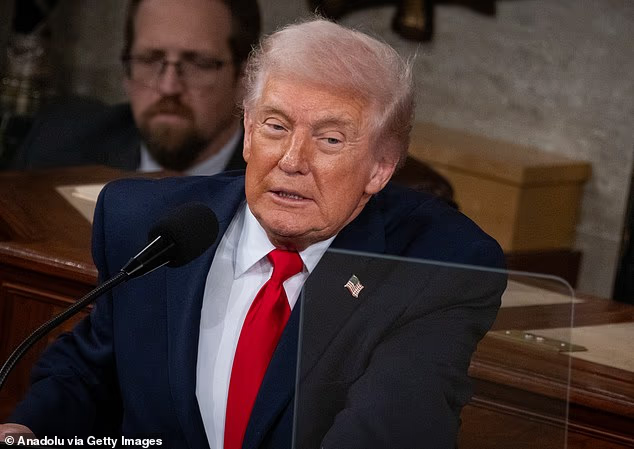
The controversy is linked to a congratulatory call between the U.S. Olympic hockey teams and President Donald Trump.
Following the men's team's victory over Canada, the team participated in a call with President Trump.
During this call, a voice, allegedly not Tkachuk's according to his statement, was heard shouting "close the northern border."
President Trump also made a remark about having to invite the women's team to the White House as well to avoid being impeached, referencing their earlier victory over Canada.
The U.S. women's team reportedly declined an invitation to the White House due to prior commitments.
Impact and Repercussions
The spread of the AI-generated video has drawn immediate criticism and scrutiny.
Read More: Australia Disaster Roaming Calls Grow After New Alert System Launch
Tkachuk's denial has served to counter the narrative presented in the fabricated video.
The incident underscores the ease with which digital media, particularly AI-enhanced content, can be used to create and spread false or misleading information.
The situation has put a spotlight on the White House's use of social media platforms and the vetting process for content shared under its official accounts.
"But if you watch the video, it’s not my voice or something that I never say,” Tkachuk said. He denied those claims on Thursday. It’s not what I was saying,” he continued. You can’t control what other people say. I would never say anything like that.”
Expert Analysis
"The use of AI-generated media, even when disclosed, presents a significant challenge. It can be incredibly difficult for the public to distinguish between genuine and synthetic content, and malicious actors can exploit this ambiguity. When official accounts disseminate such material, even with a disclaimer, it risks lending credibility to fabricated narratives." - Analysis from a digital media ethics researcher (Unnamed in sources)
"The speed at which these digital elements spread is astonishing. What might have been a private or contained event can quickly become a global news story, fueled by rapid online sharing. This case demonstrates how quickly AI-generated content can complicate public perception and individual reputation." - Observation from a social media analyst (Unnamed in sources)
Conclusion and Unanswered Questions
The available evidence strongly suggests that the White House TikTok video featuring Brady Tkachuk contains AI-generated audio that is a fabrication. Tkachuk himself has provided a clear and direct refutation of the content, citing specific reasons why the video is not representative of him. The explicit labeling of the video as containing AI-generated media further supports the conclusion that the audio is not genuine.
However, several aspects warrant further clarification:
What was the precise process for creating and approving the White House TikTok video? Understanding this could shed light on how fabricated content was shared under an official banner.
Was the intention behind posting the AI-generated video to intentionally mislead or was it an error in judgment? Without a statement from the White House addressing the specifics of their intent, this remains an open question.
What measures are in place to prevent the future dissemination of AI-generated misinformation from official government social media accounts? The lack of immediate response from the White House leaves this question unanswered.
The incident serves as a potent reminder of the evolving landscape of digital media and the critical need for vigilance in discerning truth from falsehood, especially when content is amplified by official channels.
Sources
The Independent: https://www.independent.co.uk/news/white-house-tiktok-ottawa-ontario-american-b2928453.html
Daily Mail: https://www.dailymail.co.uk/sport/winterolympics/article-15596379/team-usa-hockey-trump-brady-tkachuk-ai-video-canada.html
The Guardian: https://www.theguardian.com/sport/2026/feb/26/brady-tkachuk-decries-white-houses-ai-video-of-him-insulting-canadians-after-us-gold
The Athletic (NYT): https://www.nytimes.com/athletic/7070904/2026/02/26/tkachuk-sanderson-senators-trump-usa-olympics/
BHPioneer: https://www.bhpioneer.com/sports/nationalsports/ap-sports-summarybrief-at-3-06-p-m-est/article935d2213-35a2-56e5-b886-d2a18e463c88.html
/assets.tntsports.io/web/img/match/football-header-bg-desktop.jpg)