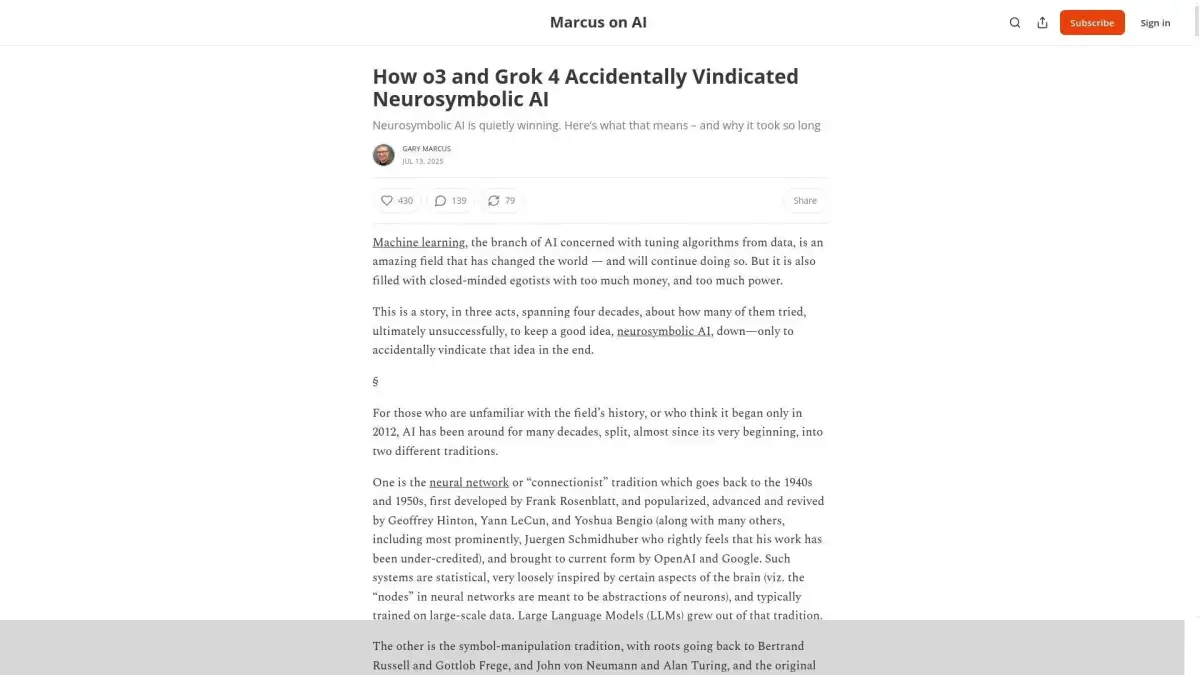
Recent developments, particularly the incorporation of classical symbolic AI techniques into large language models (LLMs), are being framed as a significant vindication for 'neurosymbolic AI'. This approach, which advocates for a fusion of neural networks and symbolic reasoning, posits that neither method is sufficient on its own. The emergent trend suggests a shift away from purely neural network-based systems towards hybrid models that leverage the complementary strengths of both paradigms. This convergence is seen by proponents as a crucial step toward more robust and capable artificial intelligence systems, moving beyond the limitations of current generative models.
Several high-profile instances appear to bolster this narrative. Reports from July 2025 highlighted how projects like o3 and Grok 4 are employing neurosymbolic methods, differing in their specific implementations but unified by the core premise of combining neural and symbolic elements. Similarly, AlphaProof, AlphaGeometry, and Claude Code are cited as examples where traditional symbolic AI's involvement, such as via code interpretation or integration of classical logic, plays a critical role in their advanced capabilities. This integration is not seen as merely adding features, but as a fundamental architectural choice.
Read More: Chrome mimeHandler API lets extensions handle file types

A Shift in Prominent Voices
A particularly striking development occurred in January 2026, when Yann LeCun, a figure historically critical of symbolic approaches, reportedly shifted his stance. LeCun's apparent move towards a neurosymbolic framework, joining a company focused on reasoning and world models, is interpreted by some as a significant endorsement. This aligns with broader industry movements noted in July 2025, where leading AI companies began integrating tools like Python interpreters into LLMs, a move some interpret as validating the neurosymbolic philosophy.
Beyond Correlation to Causation
The advantages attributed to neurosymbolic AI extend to its potential for more profound understanding and reliable outputs. Unlike purely correlational models, neurosymbolic systems are believed to be capable of uncovering 'deep causal relationships'. This allows for more nuanced analyses, moving beyond simply identifying patterns to understanding underlying drivers, a capability highlighted in December 2025. Furthermore, the explicit logic embedded in symbolic components is expected to enable more 'auditable workings' and potentially reduce instances of 'hallucinations' often associated with LLMs.
Read More: New AI Method Maps API Logic for Safety by April 7, 2026
Historical Context and Future Trajectory
The concept of neurosymbolic AI is not entirely new, with roots stretching back to at least 2001 when researchers like Gary Marcus published work exploring neural systems capable of manipulating symbols. By 2018, Marcus was advocating for deep learning to be "one tool among many," signaling a critique of its universal application. The period around 2021-2022 saw increasing integration of code generation and tool-use capabilities into AI systems, culminating in the present claims of vindication in 2025 and 2026. While LLMs are acknowledged as significant progress, the current discourse suggests they are viewed not as the final destination but as a component within a larger, hybrid intelligence architecture.
Read More: BEREC Asks for Mobile Network API Ideas from Developers
The debate surrounding neurosymbolic AI centers on the belief that achieving human-level AI necessitates a combination of pattern recognition (neural) and structured reasoning (symbolic). Critics have noted that the celebration of tool-using LLMs by some proponents of neurosymbolic AI might appear to contradict their earlier skepticism about pure LLMs, suggesting a reinterpretation of past criticisms in light of current trends. The ultimate aim, as articulated in discussions from July 2024, is the pursuit of 'trustworthy AI' and, potentially, artificial general intelligence (AGI).